

Have you ever wandered through the ancient walls of a fort and wondered what stories they hold?
Quick answer: St. Angelo Fort — also known as Kannur Fort — was built by the Portuguese in 1505 under the leadership of Dom Francisco de Almeida, the first Viceroy of India. Over the next four centuries, it changed hands between the Dutch, the Arakkal royal family, and finally the British. Today, it stands as a protected monument under the Archaeological Survey of India — a living witness to Kerala’s colonial past and maritime power.
The Setting: A Fort by the Arabian Sea
St. Angelo’s Fort stands proudly on the Arabian Sea coast in Kannur, Kerala — about 3 km from the city center and right beside Mapilla Bay, a natural harbor.
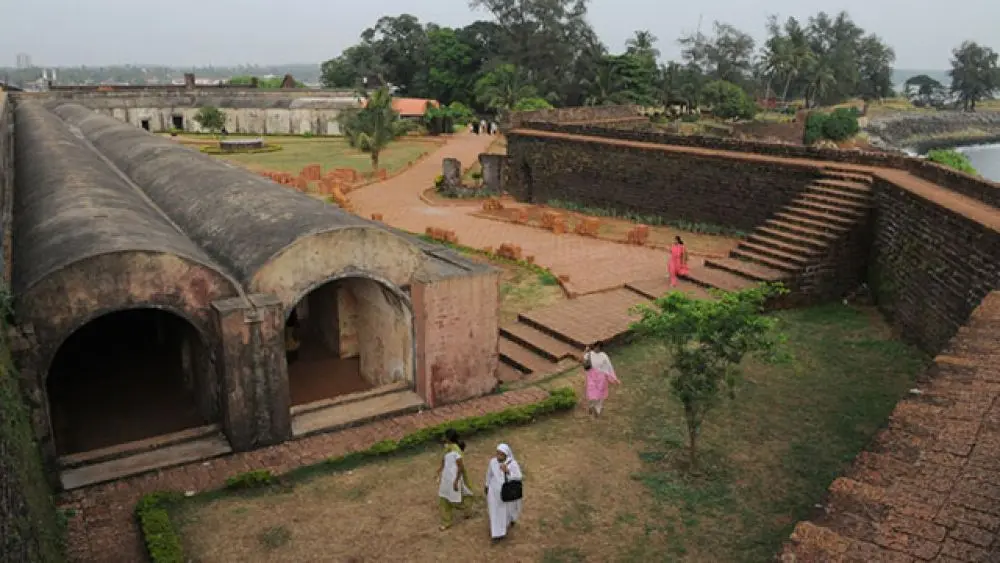
Built with laterite stone, the fort’s red walls glow beautifully under the sun. The view from the ramparts opens to the endless sea on one side and the green coastal belt on the other — a reminder of how strategic this site was for controlling trade on the Malabar Coast.
According to Kerala Tourism (2024), Kannur’s coastline once hosted some of India’s busiest spice ports, making this fort a prime point for defense and trade.
The Portuguese Era: Beginning of a Colonial Chapter
The story begins in 1505 CE, when the Portuguese, led by Dom Francisco de Almeida, built St. Angelo’s Fort after obtaining permission from the local Kolathiri Raja. It became their first stronghold in Malabar, serving as both a military base and a trading post.
The Portuguese used the fort to protect their spice trade network and maintain naval dominance over the Arabian Sea. It was here that they stored pepper, cardamom, and other valuable spices traded from inland Kerala to Europe.
In 1507, the fort came under attack by local forces, including the Zamorin of Calicut and the Kolathiri king, but the Portuguese managed to defend it successfully — proving its strategic importance.
The Dutch and Arakkal Period
After more than a century of Portuguese control, the Dutch East India Company captured the fort in 1663. They made significant architectural changes, strengthening its defense structure and adding three new bastions named Hollandia, Zeelandia, and Frieslandia — which still exist today.
The Dutch used the fort mainly for trade and military purposes, but as their influence declined, they sold it in 1772 to the Ali Raja of the Arakkal family — Kerala’s only Muslim royal dynasty, based in Kannur.
This transfer marked a local chapter in the fort’s history — the first time it came under an Indian ruler after nearly 250 years of European control.
The British Take Over
By 1790, the British East India Company seized control of the fort from the Arakkal rulers. Under British rule, it became part of their defensive network across the Malabar region.
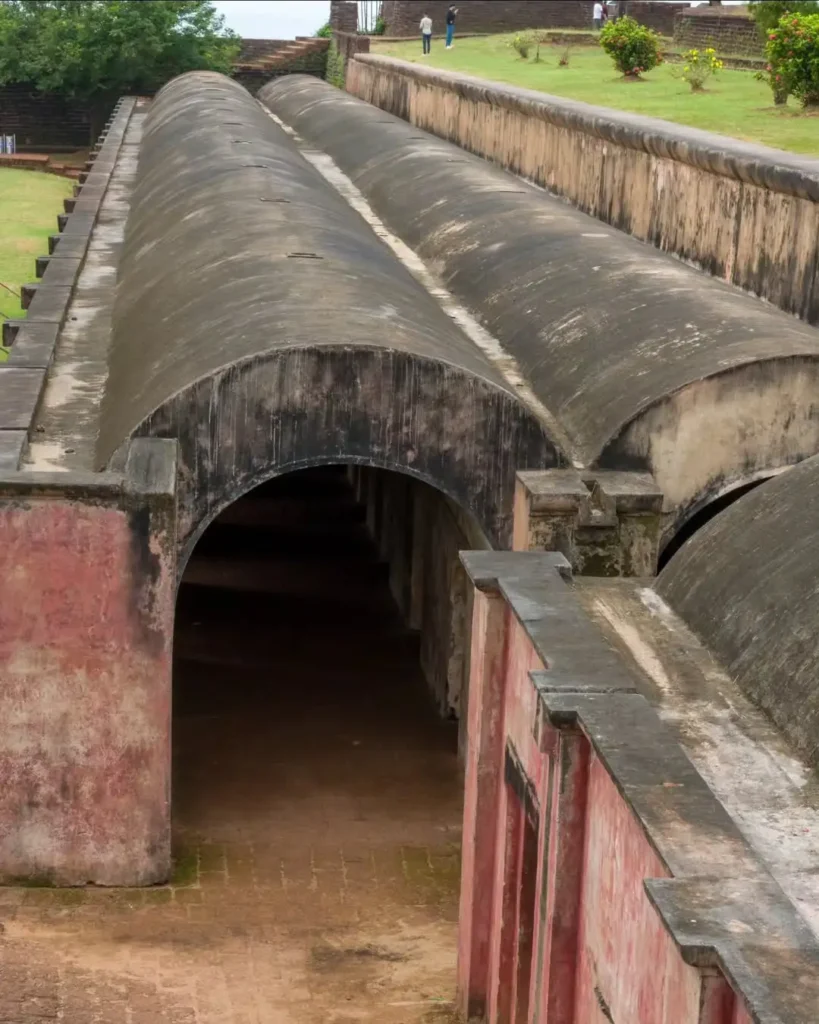
The British used it primarily as a military station and administrative outpost, overseeing both land and sea routes. They also built additional barracks and storage rooms within the compound.
Later, after India’s independence, the fort was taken over by the Archaeological Survey of India (ASI), which maintains it as a protected heritage site today.
Fact: The fort is listed under ASI’s official “Protected Monuments of National Importance” (ASI, 2024).
Architectural Beauty and Design
Even after 500 years, St. Angelo’s Fort remains one of the best-preserved European forts in India.
The structure is triangular in shape with massive laterite walls that once held heavy cannons facing the sea. You can still see:
- Deep moats surrounding the walls
- Watchtowers and old gun points
- The Dutch bastions that gave the fort its distinct layout
From the western side of the fort, visitors get a clear view of Mappila Bay, while to the north lies Dharmadam Island, another popular Kannur attraction.
Why the Fort Matters in History
St. Angelo’s Fort isn’t just a monument — it’s a history book in stone.
It tells the story of how Kerala’s coastline shaped world trade, how European empires competed for spices, and how local rulers adapted to foreign influence.
It also represents the blending of architectural styles — European military engineering mixed with Kerala’s local building materials and coastal defense systems.
Today, it attracts thousands of visitors each year, both tourists and history lovers, who come to understand how Kannur played a central role in India’s maritime and colonial story.
Visiting Tips
If you plan to visit the fort, here’s what to know:
- Location: Near Mapilla Bay, 3 km from Kannur city
- Timings: 8:00 AM – 6:00 PM (all days)
- Entry: Free (maintained by ASI)
- Distance from Kannur Airport: ~27 km
- Best Time to Visit: October to March
Pro tip: Visit during sunset — the view of the sea from the fort walls is breathtaking, especially when the old cannons cast long shadows over the laterite stone.
Conclusion
The story of St. Angelo’s Fort in Kannur is the story of Kerala’s meeting point with the world — where explorers, traders, and empires left their marks.
From the Portuguese in the 1500s to British officers in the 1800s, this fort has seen more history than any textbook could hold. Today, it stands not just as a structure of stone, but as a symbol of Kerala’s global heritage and enduring strength.