Perched on a windswept laterite plateau near Pazhayangadi, Madayi Kavu — formally known as Sri Thiruvarkkattu Kavu Bhagavathy Temple — is one of the oldest and most revered shrines in North Kerala. Local devotees simply call the deity Madayikavu Amma, or Tiruvarkkad Achchi, and regard this as the “mother temple” of every Bhadrakali shrine in the Malabar region. For travellers, it’s not just a place of worship — it’s a living piece of Kerala’s history, standing on a hilltop that also holds a centuries-old mosque and the ruins of a royal fort, side by side.
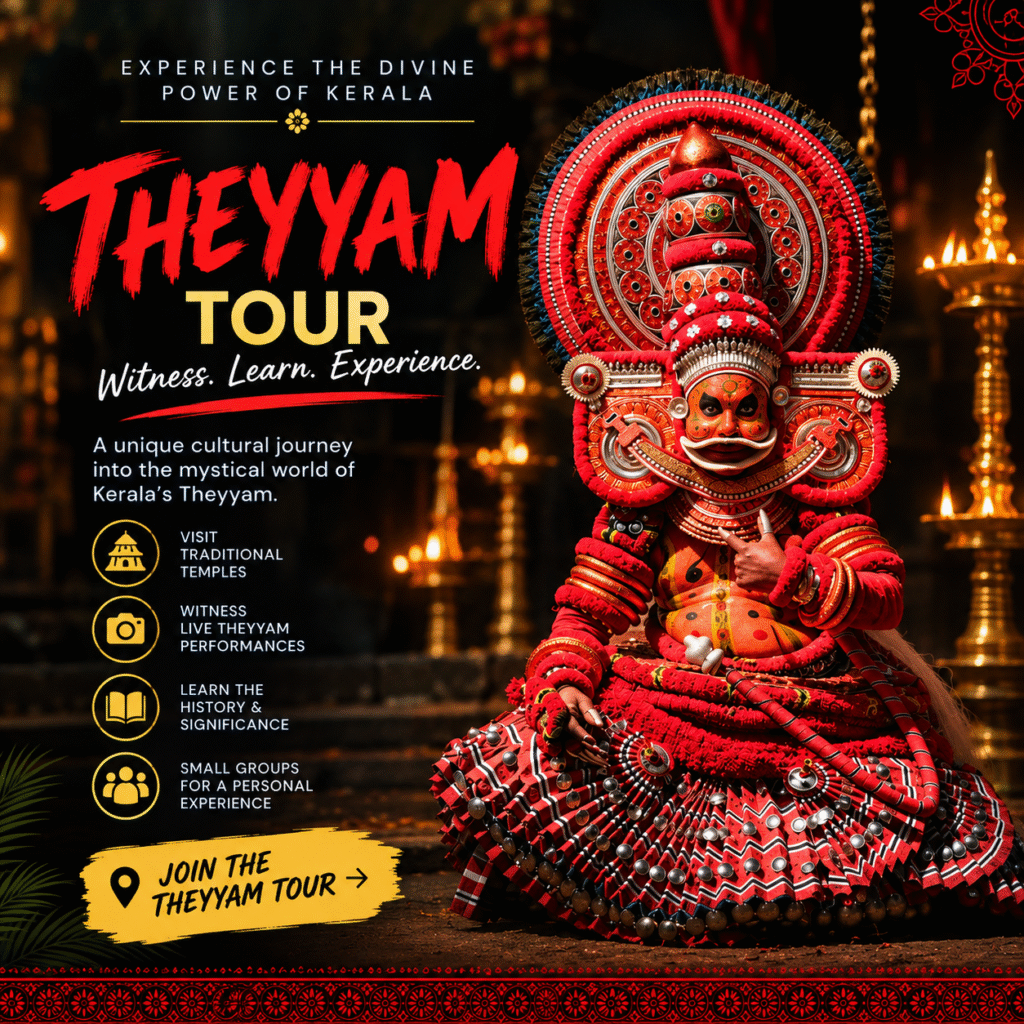
If you’re visiting Kannur for its Theyyam season, Madayi Kavu deserves a place on your itinerary — not only for its temple architecture and sacred atmosphere, but because it hosts Kaliyattam, one of the region’s most important Theyyam festivals.
Madayi Kavu’s origin stories have been passed down for generations. One legend holds that the goddess once resided at the Rajarajeshwara Temple in Taliparamba, but because her worship required non-vegetarian offerings, she could not remain within a Shiva temple — so the ruling king built her a separate shrine at Madayi. Another telling says Madayikavu Amma took form to defeat a demon terrorising the local people, after which Lord Shiva granted her a permanent seat of worship on this hill, consecrated with the help of Sage Parashurama.
Whichever version you hear from a local priest or guide, the theme is the same: Madayikavu Amma is worshipped as a fierce, protective form of Bhadrakali — a mother goddess who shields her devotees from harm, sorcery, and misfortune.
Madayi Kavu’s story runs alongside the history of the region itself:
The temple is today maintained by the Malabar Devaswom Board.
For visitors already drawn to Kannur’s Theyyam culture, Madayi Kavu is a must-visit temple town. The temple’s annual Theyyam festival, known as Kaliyattam, is held in the Malayalam month of Edavam (roughly May–June) — making it one of the later performances in the Theyyam calendar, after most other temples have concluded their season.
The other major annual event here is the Pooram festival, celebrated over seven days in the Malayalam month of Meenam (March–April), culminating in a ceremonial bath called Pooram Kuli in the nearby Vadukunda pond.
(If you’re planning your trip around Theyyam season, read our full Theyyam Tour guide for the complete October–May calendar and temple-by-temple breakdown.)
What makes Madayi Kavu genuinely unique isn’t only the temple — it’s the hilltop it sits on. Madayi Para is a flat-topped laterite plateau spread across roughly 365 hectares, and within a short walk of the temple you’ll also find:
A Hindu temple, a historic mosque, and fort ruins sharing the same hilltop for centuries make Madayi Para a striking symbol of Kannur’s layered, coexisting heritage — well worth an hour of unhurried walking beyond the temple visit itself.
Location: Madayi village, near Pazhayangadi, Kannur District, Kerala
Distance from Kannur: Approximately 25 km (roughly 40–45 minutes by road) from Kannur town / Kannur New Bus Terminal
How to reach:
Best time to visit: Weekday mornings are quieter. If you want to witness rituals rather than just the temple architecture, plan around the Pooram festival (Meenam / March–April) or the Kaliyattam Theyyam festival (Edavam / May–June).
Temple etiquette:
Prasadam note: Offerings here, including the main Akapooja, traditionally include non-vegetarian items (chicken is part of the ritual offering, known as Kozhi Kalasham). If you prefer a vegetarian-only prasadam, you can request this specifically.
What is Madayi Kavu famous for?
Madayi Kavu (Sri Thiruvarkkattu Kavu Bhagavathy Temple) is regarded as the “mother temple” of all Bhadrakali shrines in North Kerala. It’s one of the oldest temples in the region, historically linked to the Mushika, Kolathunad, and Chirakkal royal families, and is known for its Kaliyattam Theyyam festival and its scenic hilltop setting shared with an ancient mosque and fort ruins.
How old is Madayi Kavu?
The temple is widely believed to be over a thousand years old, with local tradition tracing its origins back even further. It is considered one of the oldest temples built in Kerala.
What is the significance of Madayikavu Amma?
Madayikavu Amma is worshipped as a fierce form of Bhadrakali (Mahakali), believed to protect devotees from black magic, sorcery, and misfortune. She is addressed by temple tantrics as Tiruvarkkad Achchi.
When is the Theyyam festival at Madayi Kavu?
The temple’s Theyyam festival, Kaliyattam, is held annually in the Malayalam month of Edavam (May–June).
Can tourists and non-Hindus visit Madayi Kavu?
Yes, the temple grounds and the surrounding Madayi Para plateau are open to visitors of all backgrounds. Entry into certain inner sanctum areas may be restricted to Hindu devotees — check with temple staff on arrival.
How do I reach Madayi Kavu from Kannur?
Madayi Kavu is about 25 km from Kannur town, roughly a 40–45 minute drive via NH 66 through Pazhayangadi. The nearest railway station is Pazhayangadi, and the nearest airport is Kannur International Airport.
Is there an entry fee?
No, entry to the temple is free, as with most traditional Kerala temples. Devotees typically make voluntary offerings or purchase poojas at the temple counter.
What else can I see near Madayi Kavu?
Within walking distance on the same hilltop, you can visit Madayi Palli (a mosque dating to around 1124 CE) and the ruins of Madayi Fort — making this one of the few places in Kerala where you can see Hindu, Islamic, and military heritage sites together on one plateau.