An ancient forest pilgrimage in the heart of the Western Ghats, Kannur district
Deep in the forested valleys of the Western Ghats, approximately 60 kilometres from Kannur city, lies one of Kerala’s most spiritually powerful and visually extraordinary pilgrimage destinations — Kottiyoor Shiva Temple, formally known as Sri Kottiyoor Mahadeva Kshetram. Revered across South India and beyond, this ancient Shiva shrine is popularly called Dakshina Kashi — the Varanasi of the South — a title that reflects the immense sacred weight this site carries in Hindu tradition.
What makes Kottiyoor unique is not just its mythology or antiquity, but its extraordinary relationship with nature. Unlike most temples in Kerala, the primary shrine here has no roof, no walls, and no permanent structure. The Swayambhu Shiva Linga — a self-manifested lingam believed to have emerged from the earth itself — sits on a simple platform of river stones called the Manithara, in the middle of a shallow sacred pond called the Thiruvanchira, surrounded entirely by dense forest. Devotees wade barefoot through the Bavali River to reach it, and the experience is widely described as one of the most raw, primal, and emotionally overwhelming acts of worship in all of India.
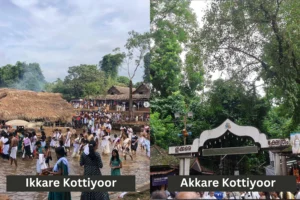
Kottiyoor is not one temple but two — a twin-shrine complex situated on opposite banks of the Bavali River, each with a distinct nature and schedule.
Ikkare Kottiyoor (meaning “this side of the bank” in Malayalam), also called Vadakkeshwaram Temple or Thruchherumana Temple, is a permanent, structured temple complex on the western bank. It follows a conventional temple format and remains open to devotees throughout the year, except during the Vysakha Mahotsavam period when it temporarily closes so that attention shifts entirely to the festival shrine across the river.
Akkare Kottiyoor (meaning “the opposite bank”) is the legendary seasonal forest shrine on the eastern bank. This is the site of the mythological Daksha Yaga and is considered the holiest spot. It has no permanent structure by religious injunction — only the stone platform Manithara with the Swayambhu Linga, and the nearby Ammarakkallu Tara, a second stone platform representing Goddess Sati. Akkare Kottiyoor opens for just 28 days each year during the Vysakha Mahotsavam festival, drawing over one lakh devotees from across Kerala, Karnataka, and Tamil Nadu.
In 2026, the festival runs from May 23 to June 24
Why Kottiyoor is one of the most mythologically significant spots in Hindu India
Kottiyoor’s spiritual gravity flows directly from one of Hindu mythology’s most dramatic episodes — the Daksha Yaga. According to the Puranas, Daksha Prajapati, father of Goddess Sati and a powerful king of the gods, organised a grand yajna (fire sacrifice) at this very location. He deliberately excluded his daughter Sati and her husband Lord Shiva, whom he considered unworthy of the ceremony.
Sati arrived uninvited, only to be publicly humiliated by her father’s words against Lord Shiva. Unable to bear the insult to her husband, she immolated herself in the sacrificial fire using her yogic power — a moment of profound grief and anger that shook the three worlds. When Lord Shiva learned of Sati’s death, his grief turned to fury. He performed the Thandavanritham (the cosmic destructive dance) in his form as Veerabhadra, destroyed the yajna, and beheaded Daksha. The site where all of this unfolded — including the legendary pacification of Shiva when Lord Vishnu embraced the Swayambhu Linga in an act called Aalinganam — is believed to be the sacred ground of Kottiyoor today.
The name Kottiyoor is said to derive from Koodiyoor, meaning “the place where the gods came together” — Brahma, Vishnu, and Shiva are believed to have met here, infusing the site with the divine energy of the Trimurti. Kottiyoor is also recognised as one of India’s rare Shakti Peethas, sacred sites associated with the body of Sati Devi.
The rituals of the annual festival are specifically designed to commemorate and re-enact these mythological events. The embrace of the Shiva Linga by the priest during Rohini Aaradhana, for instance, echoes Vishnu’s act of pacification — a ritual not found in any other temple in India, according to temple scholars.
The temple is also associated with Shankaracharya, the great 8th-century Hindu philosopher, who is credited with restoring and systematising the temple’s rituals during his tour of India.
The Aayilyar Kavu, a dense snake grove in front of the Ikkare temple, is another sacred element of the complex — a carefully protected natural habitat for serpents, birds, and wildlife that no ordinary visitor may enter, except for two specific days each year when midnight rituals are conducted at the Kavu.
The 28-day festival that draws over a lakh devotees every year — dates, rituals, and what to expect
The Kottiyoor Vysakha Mahotsavam (also called Vaishaka Maholsavam or Kottiyoor Ulsavam) is one of the most significant annual festivals in North Kerala. In 2026, the festival runs from May 29 to June 24, 2026. During this period, Akkare Kottiyoor is open to the public and the forest comes alive with chanting, rituals, and the energy of thousands of pilgrims who walk barefoot through the Bavali River to offer prayers.
The festival is remarkable for its community participation. Families and communities from across Kannur and beyond have been assigned specific ritual duties by the historic Kottayam (Pazhassi) royal family — duties that have been carried out without interruption for centuries. Each group brings specific offerings: firewood, raw materials, sacred objects, and flower arrangements called Odapoo (an artificial flower crafted from bamboo fibre, resembling a white beard — symbolically linked to the sage Bhrigu’s beard from the Daksha Yaga legend, and taken home by devotees as sacred prasadam).
| Ritual | Description | Significance |
|---|---|---|
| Neyyattam | Ablution of the Swayambhu Linga with ghee; begins with a sword brought from Muthirerikavu, Wayanad | Opening ritual of the entire festival |
| Bhandaram Ezhunnallath | Gold and silver vessels, ornaments brought in procession from Manathana village to Kottiyoor | Commemorates divine offerings; held on the Visakham star day |
| Elaneer Vayppu | Thousands of tender coconuts, carried from across Malabar, are offered before the Swayambhu Linga | One of the most visually spectacular devotional acts of the festival |
| Elaneerattam (Rashi Velli) | Chief priest pours tender coconut water, collected in gold and silver pots, over the Shiva Linga | Sacred cleansing ritual unique to Kottiyoor |
| Rohini Aaradhana | The senior Kurumathur Brahman (embodiment of Vishnu) embraces the Swayambhu Shiva Linga | Re-enacts Vishnu pacifying Shiva; not seen in any other temple in India |
| Ezhunnallippu | Grand procession with idols of Lord Shiva and Goddess Parvati carried on caparisoned elephants | Festival centrepiece with traditional temple music |
| Aanayootu | Ceremonial feeding of elephants with cooked rice and other offerings | Ritual honouring the role of elephants in sacred processions |
| Thrikkalashaattu | Final ritual concluding the 28-day festival | Closing ceremony; Akkare Kottiyoor returns to forest seclusion |
Women visitors (2026): Entry to Akkare Kottiyoor for women is permitted from May 31 to June 20, until noon each day. Outside these dates, women are restricted from the eastern shrine. Traditional dress (saree or chudidhar) is mandatory. Salwar kameez and modern attire are not allowed.
Kannur International Airport (CNN) is the nearest airport, approximately 55 km from Kottiyoor (around 1.5 hours by road). Taxis and rental cars are available from the airport. Calicut International Airport (CCJ) is a farther alternative at ~125 km.
Thalassery Railway Station (~60 km) is the closest. Kannur Railway Station (CAN) is ~70 km away, on the Mangalore–Palakkad rail line. From both stations, KSRTC buses and hired taxis connect to Kottiyoor.
KSRTC and private buses operate regularly from Kannur, Kozhikode, Mananthavady, and Thalassery. During festival season, additional services are scheduled. Local buses from Iritty and Kelakam also connect to the temple area.
From Kannur city: ~63 km via Malayora Highway (1.5–2 hrs). From Kozhikode: via Thalassery–Iritty route (~100 km). From Bengaluru: ~300 km via Mysore road and Mananthavady. Parking is available at the temple.
Tip: The approach road to Kottiyoor winds through forested hills and may be narrow in sections. During heavy monsoon months (June–August), check road conditions before travel. During festival season, arrive early in the morning to avoid peak crowd hours and long queues.
Combine your pilgrimage with these nearby natural and cultural attractions in Kannur’s eastern forest region
~54 km · Ancient Maha Vishnu temple in Wayanad’s forests; spiritually linked to Kottiyoor
~9.4 km · Scenic cascade with herbal gardens and nature trails on the mountain path to Mananthavady
~12 km · Rich biodiversity reserve — ideal for birdwatchers, trekkers, and wildlife enthusiasts
Adjacent · The dense forest surrounding the temple complex; part of the Western Ghats ecosystem
~40 km · Famous Muthappan temple on the Valapattanam river — popular day trip from Kannur
~35 km · Renowned temple known for the Peralassery Thalappoli festival in Kannur
~25 km · Nearest commercial hub with hotels, restaurants, and amenities for overnight stays
~24 km · Gateway to Wayanad’s tribal villages, spice plantations, and eco-lodges
For the full festival experience: Visit during the Vysakha Mahotsavam (May–June). This is the only time Akkare Kottiyoor is accessible, and the spiritual energy, rituals, and processions make it a once-in-a-lifetime experience. Book accommodation at least 2–3 months in advance during festival season.
For a quieter darshan: Visit Ikkare Kottiyoor between October and March, when the weather is cool and crowds are minimal. The permanent temple is open year-round (except during festival season) for regular poojas and morning abhishekam.
Avoid: Peak monsoon (July–September) if you are travelling by road, as the forested mountain routes can be challenging in heavy rain.
Staying options near the temple include Devaswom guesthouses (book through official channels well in advance), basic lodges in Kottiyoor village, and mid-range hotels in Iritty (~25 km). Kannur city (~60 km) offers the widest range of hotels and resorts, including budget to premium options, and is recommended for first-time visitors who prefer greater comfort and connectivity.
To reach Akkare Kottiyoor during the festival, devotees must wade through the shallow waters of the Bavali River barefoot. The river carries water that has flowed through the medicinal herb-rich valleys of the Western Ghats and Wayanad — many devotees drink the water, believed to have healing properties. The crossing is considered an act of purification and spiritual preparation before standing before the Swayambhu Linga.
Everything visitors ask about Kottiyoor Shiva Temple — answered for your planning
In a land filled with magnificent temples, Kottiyoor stands apart not by grandeur of architecture but by the absence of it. The Swayambhu Shiva Linga at Akkare Kottiyoor has no sanctum, no tower, no gold-plated flagpole. It is an ancient stone, in a pond, in a forest, in the mountains — and that is precisely why millions have walked through rivers to reach it for centuries.
The temple embodies the concept that divinity is not contained in walls but in the space where nature, myth, and human devotion converge. Kottiyoor is a Shakti Peetha, a Shaiva pilgrimage, a Vaishnava ritual site, and a celebration of Shaiva-Vaishnava-Shakteya communal harmony — all in one 80-acre sacred grove.
For travellers visiting Kannur, Kottiyoor is not simply a temple to check off a list. It is a place that asks something of you — barefoot on river stones, in forest air, without a camera, simply present. Whether you visit during the charged energy of the Vysakha Mahotsavam or in the quiet of the off-season for a contemplative darshan at Ikkare, Kottiyoor will leave a mark that is difficult to describe and impossible to forget.
From Kannur’s beaches and forts, the road east into the Western Ghats is a journey through Kerala’s soul — and Kottiyoor is where that journey reaches its deepest point.