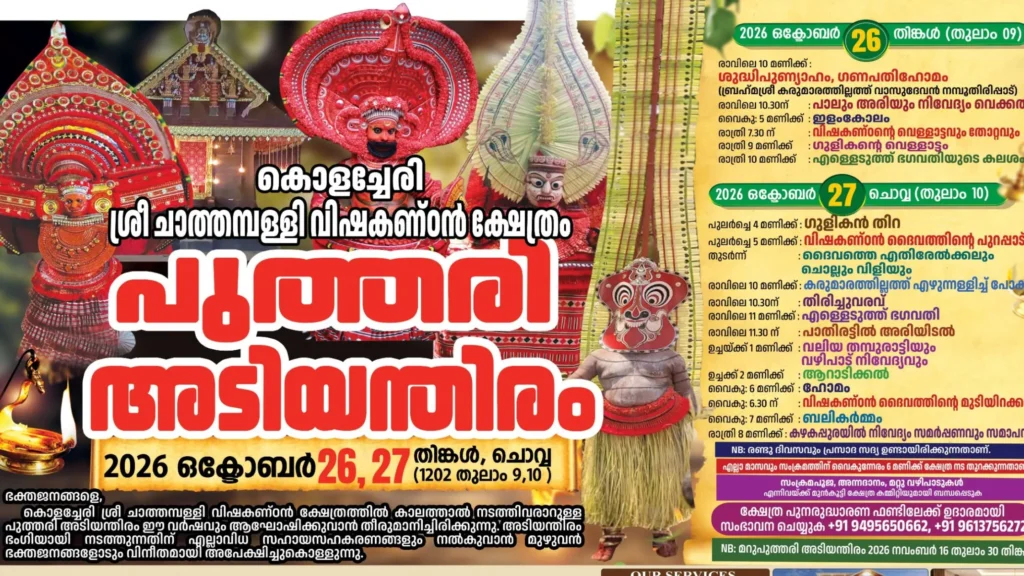
Every year, long before the rest of North Malabar’s temples light their first ritual fires, one small shrine on the outskirts of Kannur quietly opens the entire Theyyam season. That shrine is the Kolachery Sree Chathampally Vishakandan Kshetram, popularly known as Chathamballi Kaavu, and in 2026, its annual festival — known locally as Puthari Adiyanthiram — falls on October 26 and 27 (Monday and Tuesday), corresponding to Thulam 9–10, Malayalam Era 1202.
“Puthari Adiyanthiram” translates roughly to “new-harvest ritual observance” — the festival combines the Theyyam performances with traditional new-rice/harvest offerings, tying the temple’s ritual calendar to the paddy harvest season, which is part of what makes it such a distinctive, early-season festival in the Kannur Theyyam circuit.
If you’re chatting with locals in Kannur, you’ll often hear Theyyam itself referred to as “Thambachi” — a Kannur-dialect slang term for Theyyam, not specific to this kaavu. Don’t be surprised if someone says “Thambachi kaanan povukayaanu” (going to watch Thambachi) instead of using the word “Theyyam.”
We live just 1.5 km away in Karinkalkuzhi and have grown up attending this festival, so this guide is written with first-hand, on-the-ground detail rather than secondhand information.
If you’ve been searching for “first Theyyam of the season in Kannur” or wondering where to begin your Theyyam journey this year, this guide covers everything: the dates, the deities, the rituals, how to get there, and how to watch respectfully as a first-time visitor.
Quick Facts: Chathamballi Kaavu Theyyam 2026
| Detail | Information |
|---|---|
| Full temple name | Kolachery Sree Chathampally Vishakandan Kshetram |
| Popularly known as | Chathamballi Kaavu |
| Festival name | Puthari Adiyanthiram (new-harvest ritual observance) |
| Festival dates | October 26–27, 2026 (Monday–Tuesday) |
| Malayalam calendar dates | Thulam 9–10, Malayalam Era 1202 |
| Venue | Chathamballi Kaavu (Chathamballi Temple), Kannur district, Kerala |
| Local term for Theyyam | Often called “Thambachi” in Kannur slang |
| Significance | Traditionally marks the opening of the annual Theyyam season in North Malabar |
| Theyyams performed | Vishakandan (the temple’s signature deity, performed nowhere else), Gulikan, Valiyathamburatti, Elleduthu Bhagavathi, Ilam Kolam |
| Nearest landmark | E.P. Krishnan Nambiar Smaraka A.L.P. School |
| Annadhanam (community feast) | Served on both days, afternoon and night |
| Nearest famous temple | Parassini Kadavu Muthappan Temple (approx. 6.7 km by road) |
| Nearest place to stay | Parassini Kadavu — clean, comfortable hotel rooms available |
| Nearest city | Kannur town |
| Nearest airport | Kannur International Airport (CNN) |
| Nearest railway station | Kannur Railway Station |
| Entry fee | Free (as with all Theyyam rituals; voluntary offerings welcome) |
| Dress code | Modest, traditional clothing recommended |
Note on dates: Theyyam festivals across Malabar are fixed according to the Malayalam calendar, not the Gregorian one, and each temple committee confirms the exact schedule only a short while in advance. The Oct 26–27 dates for Chathamballi Kaavu are consistent with the temple’s long-standing Thulam 9–10 tradition, but as with any Theyyam festival, it’s worth confirming the exact timing with the local temple committee or your guide a few days before you travel.
Why Chathamballi Kaavu Is Considered Kannur’s “Season Opener”
Kerala’s Theyyam season runs roughly from October to May, with the vast majority of temples holding their Kaliyattam (annual Theyyam festival) between December and April. Chathamballi Kaavu is one of a small handful of shrines — alongside a few others in the Payyanur and Mathamangalam belt — that hold their festival right at the very start of Thulam, making it one of the earliest Theyyam rituals of the entire year in the Kannur region.
For visitors, this matters in a very practical way: if you’re arriving in Kerala in late October and don’t want to wait until the peak December–February season, Chathamballi Kaavu gives you a genuine, ritual-accurate Theyyam experience — not a staged demonstration — right at the start of your trip.
making it one of the earliest Theyyam rituals of the entire year in the Kannur region, and one of the very first chances each season to experience an authentic cultural festival in North Malabar.
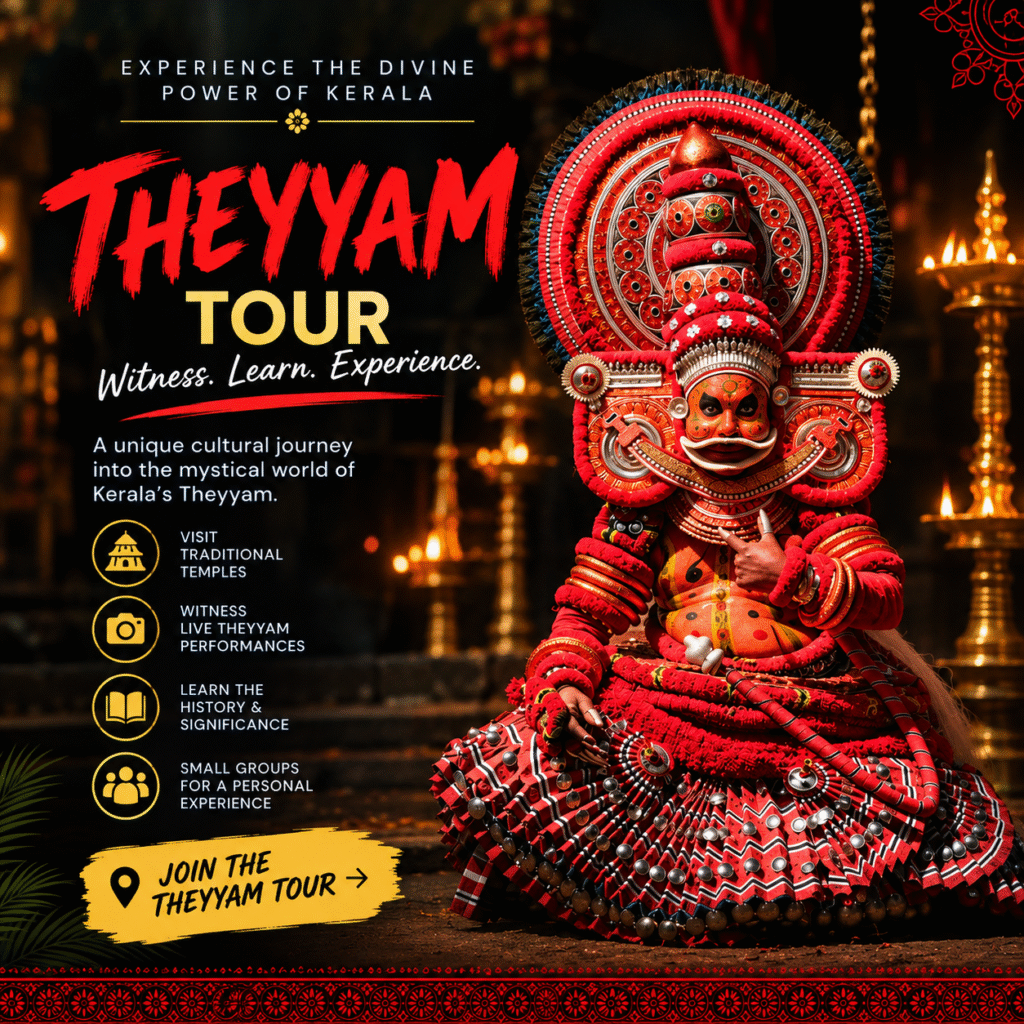
If you’d rather not navigate the timings and rituals on your own, you can join a guided theyyam tour that takes care of transport, local etiquette, and timing so you don’t miss the key moments.
What Is Theyyam? A Quick Primer for First-Time Visitors
Theyyam (also spelled Theyyattam) is a ritual art form unique to North Kerala’s Malabar region, primarily practised in Kannur and Kasaragod districts. It is far more than a dance performance — it is a living form of worship in which a performer, after hours of elaborate makeup, costume, and ritual preparation, is believed to become a temporary vessel for a deity, ancestor-spirit, or local hero.
A few things make Theyyam distinct from other Indian ritual art forms:
- It happens at the shrine itself, not on a stage — usually in the open courtyard of a kavu (sacred grove) or ancestral tharavadu (family shrine).
- The performer is in a trance state, and devotees line up to receive blessings, ask questions, or seek resolution to personal and family matters directly from the “deity.”
- Costumes and headgear are extraordinary — built from arecanut palm fronds, coconut leaves, tender palm leaves, natural pigments, and in some cases, real fire.
- There are over 400 documented forms of Theyyam, each tied to a specific myth, deity, or historical figure, and each with its own music, face painting pattern (mukhathezhuthu), and choreography.
- The ritual runs on its own schedule, regardless of audience size — a Theyyam does not “perform for tourists”; visitors are welcomed to observe an act of worship that would happen with or without them.
If you’d like to understand each of the individual stages of theyyam in more depth — from the invocatory Thottam through to the full costumed manifestation — our dedicated guide breaks the entire sequence down step by step.
The Theyyams of Chathamballi Kaavu
Five theyyams are traditionally performed across the two-day festival at Chathamballi Kaavu — with Vishakandan as the temple’s defining, must-see form:
1. Vishakandan Theyyam — Chathamballi Kaavu’s Signature Deity
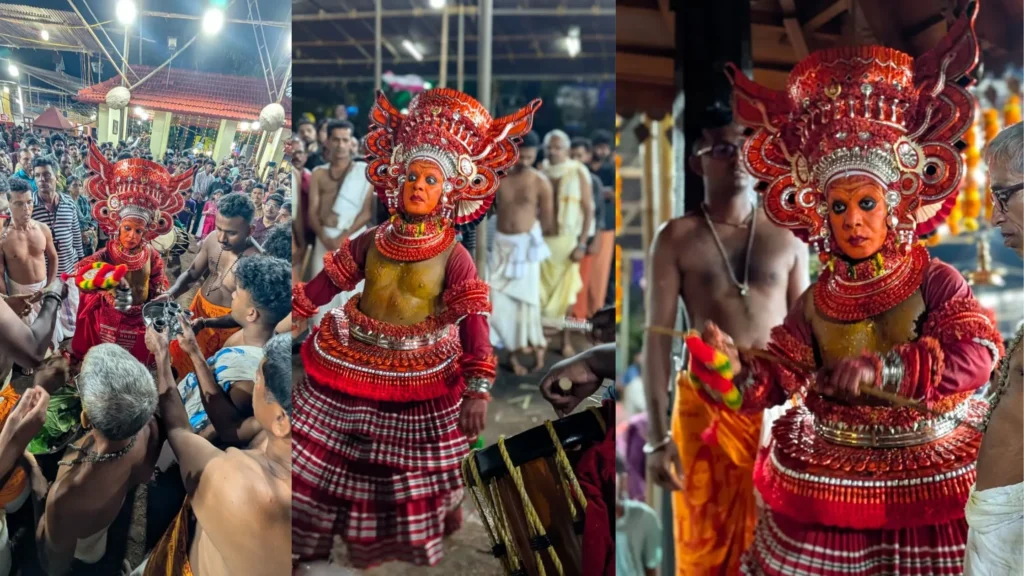
Chathamballi Kaavu is best known for Vishakandan Theyyam, and this is a genuinely rare distinction — unlike Gulikan or Vishnumoorthy, which appear at dozens of kavus across Kannur, Vishakandan is performed at only this one shrine. If you’re travelling specifically to see a Theyyam form you won’t find anywhere else, this is it.
The legend: Like several Theyyam origin stories in North Malabar, Vishakandan’s legend follows the pattern of a gifted, low-caste healer who is wronged by someone more powerful and is deified after death. According to the oral tradition associated with this kaavu, the story centres on a young man named Kandan, a folk healer skilled in treating snakebite and poison-related ailments, who once revived a woman a local physician had already pronounced dead. His growing reputation is said to have provoked the physician’s jealousy, and Kandan was later killed. Afterwards, misfortune struck the physician’s household, and it was only resolved — according to the legend — by consecrating Kandan’s spirit and instituting an annual Theyyam in his honour. This is the accepted local story behind Vishakandan’s presence at Chathamballi Kaavu, though as with most Theyyam legends, versions and details can vary slightly depending on who’s telling it — this is exactly the kind of detail worth confirming with the temple’s oracle or elders for the full, accurate version.
Ritual timing: According to the temple’s official festival notice, Vishakandan is performed multiple times across the two days: a preliminary Vellattam and Thottam on Day 1 evening (around 7:30 PM), the main Purappad (the deity’s ceremonial emergence) at 5:00 AM on Day 2, and a further evening appearance around 6:30 PM on Day 2. If you only have time to see one moment, the early-morning Purappad on October 27 is traditionally considered the most significant.
Face and makeup (mukhathezhuthu): Like most tribal-origin theyyams, Vishakandan’s face painting uses natural pigments in red, black, yellow and white, applied in the sharp geometric and floral patterns typical of North Malabar’s ritual face-painting traditions. The colours carry symbolic weight — red and black in particular are associated with divine and protective energy across almost all Theyyam forms.
Costume: Expect the classic elements of a tribal/folk-deity theyyam: a tall headgear (mudi) built from arecanut palm fronds and tender coconut leaves, ornaments crafted from natural materials, and a skirt-like lower garment made of dried palm leaves. As a deity associated with curing poison and snakebite, Vishakandan’s iconography (and the invocatory thottam pattu sung before the performance) is likely to carry references to healing and antidote — a distinctive thread worth listening for if you understand Malayalam, even at a basic level.
(If you’ve grown up attending this festival, this is the single most valuable section of the entire article to correct and expand in your own words — the exact face painting style, the specific verses sung, and the precise version of the legend as told at Chathamballi Kaavu will make this section unmatched anywhere else online.)
2. Gulikan Theyyam
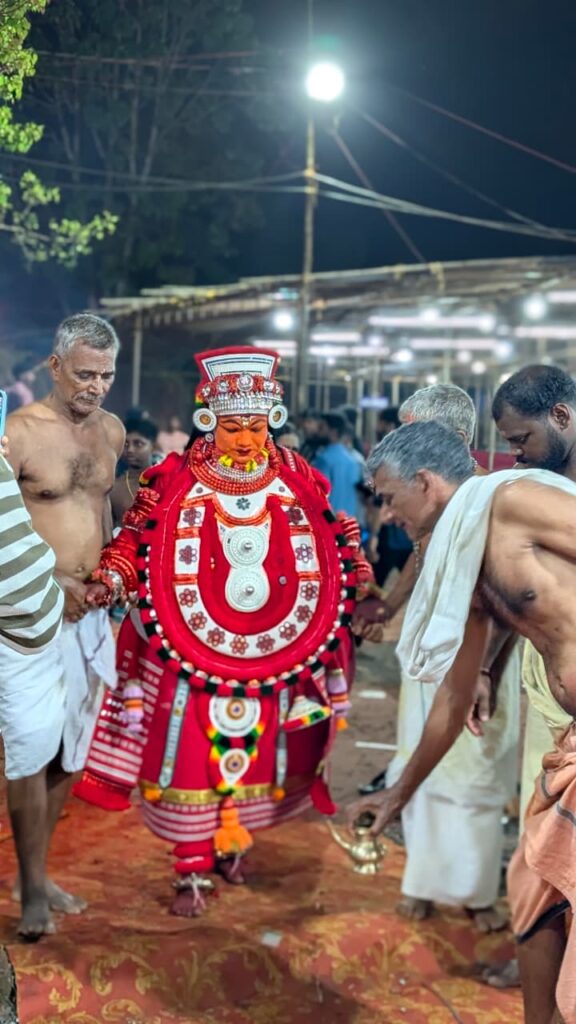
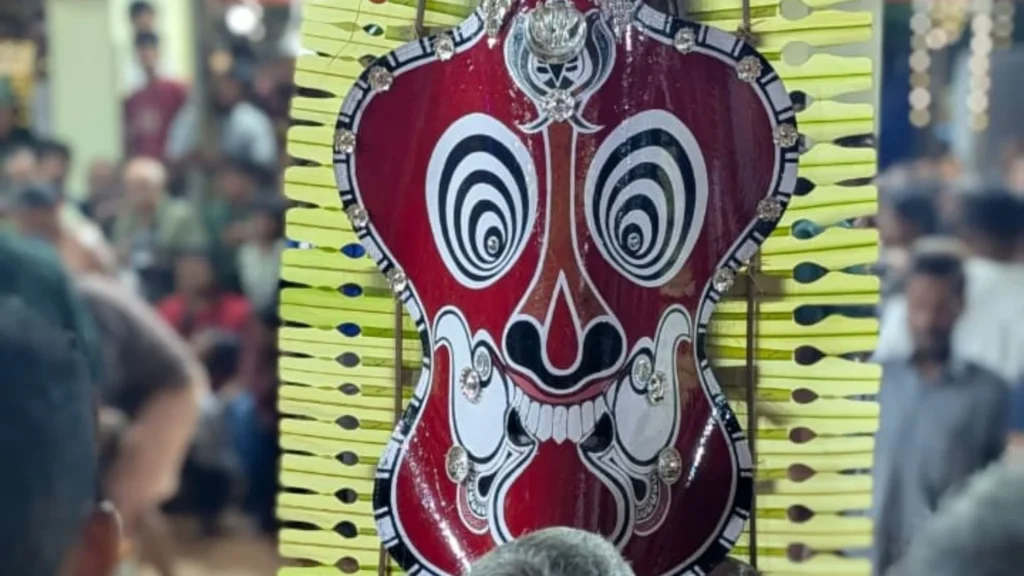
Gulikan is one of the most important and widely performed theyyams in the entire Kaliyattam tradition — almost no major Theyyam festival is considered complete without a Gulikan appearance. Gulikan represents a fierce local form associated with Yama, the Hindu god of death, and according to popular legend, was born from Lord Shiva’s left toe. The theyyam is known for its towering arecanut-palm headgear and unpredictable, intense dance movements. Devotees consider Gulikan to be a protector figure despite — or because of — its fearsome appearance.
3. Valiyathamburatti Theyyam
Valiyathamburatti (“the great/elder queen”) is a goddess form performed in several ancestral kavus across Kannur, typically representing a matriarchal or protector-goddess figure tied to that specific shrine’s family lineage. As with most goddess theyyams at family and village kavus, the exact legend behind the Chathamballi Kaavu Valiyathamburatti is a local, orally-transmitted tradition — part of what makes visiting a kavu like this, rather than a larger, more commercialised temple, a genuinely intimate cultural experience.
4. Elleduthu Bhagavathi
Elleduthu Bhagavathi is performed late on Day 1 (around 11:00 PM, October 26), as part of the night sequence following the Gulikan Vellattam.
5. Ilam Kolam
Ilam Kolam — literally a “young/junior form” — is performed early in the Day 1 evening sequence (around 5:00 PM, October 26), ahead of the main Vishakandan Vellattam and Thottam, as part of the ritual build-up before the fully costumed main theyyams appear later that night.
Official Festival Schedule: Puthari Adiyanthiram 2026
The temple’s official festival notice lists the following programme. Timings are as printed on the notice; as with any live ritual, small shifts on the day are normal, so treat these as a reliable guide rather than a rigid clock.
Day 1 — Monday, October 26, 2026 (Thulam 9)
| Time | Programme |
|---|---|
| 10:00 AM | Shuddhi Poonaham and Ganapati Homam (performed by Brahmasree Kumarathil Vasudevan Namboothirippad) |
| 10:30 AM | Nivedyam offering at the Pampum Thara (snake shrine) |
| 5:00 PM | Ilam Kolam |
| 7:30 PM | Vishakandan’s Vellattam and Thottam |
| 9:00 PM | Gulikan Vellattam |
| 11:00 PM | Elleduthu Bhagavathi’s darshan/kazhcha |
Day 2 — Tuesday, October 27, 2026 (Thulam 10)
| Time | Programme |
|---|---|
| 4:00 AM | Gulikan Thira (the main, fully costumed Gulikan performance) |
| 5:00 AM | Vishakandan’s Purappad (the deity’s ceremonial emergence), followed by welcoming rites and invocatory chants |
| 10:30 AM | Procession (Adiyanthiram purappad) around the kaavu premises |
| 11:30 AM | Return of the procession |
| 1:00 PM | Announcement at the Pathiri, and Valiyathamburatti Devi’s vazhipad nivedyam |
| 2:00 PM | Annadhanam (community meal) |
| 6:00 PM | Evening rites at the kaavu |
| 6:30 PM | Vishakandan’s evening appearance |
| 7:00 PM | Bali karma (ritual offerings) |
| 8:00 PM | Ashtamangalya nivedyam offering and closing procession |
A note on accuracy: this schedule is transcribed from a photograph of the temple’s printed festival notice. Malayalam ritual terminology in small print can be easy to misread, so if you’re local and can verify any line against the original notice, corrections are very welcome — this is exactly the kind of precision that makes a guide like this genuinely useful.
Annadhanam: The temple serves annadhanam (a free community meal) on both days, in the afternoon and again at night — a good anchor point if you’re unsure of the exact ritual timings.
Given the schedule runs from mid-morning on Day 1 through late night on Day 2, most visitors plan to attend across both days rather than trying to catch everything in one visit. The two unmissable moments, if you can only choose a few, are the Vishakandan Purappad at 5:00 AM on Day 2 and the Gulikan Thira at 4:00 AM on Day 2.
How to Reach Chathamballi Kaavu
- By air: Fly into Kannur International Airport (CNN), the most convenient gateway to all of North Kerala’s Theyyam belt.
- By train: Kannur Railway Station is well connected to major Indian cities and is the most common arrival point for domestic and international travellers heading into the Theyyam circuit.
- By road: Chathamballi Kaavu is reachable by local roads from Kannur town; given that rural approach roads to smaller kavus can be narrow and poorly signed at night, it’s strongly recommended to travel with a local driver or guide, particularly if you’re attending after dark.
- Landmark to navigate by: The easiest reference point for maps or asking locals for directions is the E.P. Krishnan Nambiar Smaraka A.L.P. School, right next to the kaavu.
If you’re arriving from outside Kerala, it’s worth first reading our general guide on how to reach Kannur, which covers flights, trains, and road routes into the district before you narrow down to Chathamballi Kaavu specifically.
If you’re coordinating your trip through Cannanore Tourism, we can arrange transport, a local guide familiar with the ritual sequence, and — because timings shift — real-time confirmation of the schedule before you set out.
For More Information
For festival-related queries, support, or contributions, the temple committee can be reached at the numbers listed on the official festival notice: +91 94956 50662 and +91 96137 56272.
Photography, Etiquette & What to Wear
Theyyam is a religious ritual first and a spectacle second. A respectful visit makes all the difference — both for you and for the community hosting it.
- Dress modestly. Shoulders and knees covered is a safe baseline; avoid shorts, sleeveless tops, or anything overly casual.
- Ask before photographing devotees up close, especially during moments of personal blessing or trance. The theyyam performer and general ritual scene are generally fine to photograph, but be sensitive around individual worshippers.
- Don’t use flash directly at the performer’s face, particularly during fire-related rituals.
- Footwear comes off near the shrine area, as at any Kerala temple.
- Keep a respectful distance unless invited closer by temple officials — some rituals involve fire, and the performer’s movements can be sudden and fast.
- Alcohol and non-vegetarian food are typically prohibited on temple premises during the festival — check locally.
- Bring a torch/flashlight and mosquito repellent if attending night sessions, as these are rural, minimally lit temple grounds.
Where to Stay Near Chathamballi Kaavu
The most convenient base is Parassini Kadavu, just 6.7 km by road from Chathamballi Kaavu and home to the famous Parassini Kadavu Muthappan Temple — one of the most visited temples in the region, known for its daily Theyyam rituals year-round (unlike most kavus, where Theyyam is strictly seasonal). Parassini Kadavu has neat, clean hotel rooms available at a range of budgets, and staying here lets you combine your Chathamballi Kaavu visit with a trip to the Muthappan temple, which sits right on the scenic Valapattanam river.
Alternatively, Kannur town offers a wider range of hotels and homestays and puts you within reach of multiple Theyyam venues across the district during the season — useful since nearby kavus (Mathamangalam, Payyanur, Cherukunnu) often hold their festivals in the same Thulam 9–12 window, so you can potentially catch more than one festival on the same trip.
Frequently Asked Questions
When is the Chathamballi Kaavu Theyyam festival in 2026?
The festival — known locally as Puthari Adiyanthiram — is scheduled for October 26–27, 2026 (Monday–Tuesday), corresponding to Thulam 9–10, Malayalam Era 1202, at the Kolachery Sree Chathampally Vishakandan Kshetram, popularly known as Chathamballi Kaavu.
Is Chathamballi Kaavu really the first Theyyam of the season?
It’s among the earliest. Theyyam season in North Malabar generally spans October to May, and Chathamballi Kaavu’s Thulam 9–10 festival falls right at the start of that window, alongside a small number of other early-season kavus in the Payyanur–Mathamangalam belt. The bulk of Kannur’s Theyyam festivals happen later, between December and April.
Do I need tickets or permission to attend?
No. Theyyam is a public ritual and open to devotees and visitors free of charge. Voluntary offerings at the shrine are welcome but not required.
Is Theyyam safe to watch for tourists, including families?
Yes, Theyyam is regularly watched by international visitors, photographers, and researchers. Some sequences involve fire or intense trance movements, so young children should be kept a safe, supervised distance from the performance area.
What should I wear to a Theyyam festival?
Modest, traditional clothing is recommended — covered shoulders and knees, and footwear that’s easy to remove, since shoes come off near the shrine.
Can I take photographs during the ritual?
Generally yes for the performance itself, but ask before photographing individual devotees during personal blessings, and avoid using flash directly at performers.
How long does the Chathamballi Kaavu festival last?
The core festival spans two days (October 26–27), though individual ritual sequences — including overnight preparation and performance — can run well beyond standard daytime hours.
What’s the easiest landmark to find Chathamballi Kaavu?
The E.P. Krishnan Nambiar Smaraka A.L.P. School, located right next to the kaavu, is the most reliable landmark for navigation or for asking locals for directions.
What is the story behind Vishakandan Theyyam?
Vishakandan’s legend follows the classic North Malabar pattern of a gifted healer wronged in life and honoured as a deity after death. Local oral tradition ties it to a folk healer skilled in treating snakebite and poison, whose growing fame is said to have led to his death — after which the community began the annual Theyyam to honour his spirit. As with most Theyyam legends, the exact details are passed down orally and can vary slightly by source.
What time does the Vishakandan Purappad happen?
According to the official festival notice, Vishakandan’s main Purappad (ceremonial emergence) takes place at 5:00 AM on Day 2 (October 27, 2026), following the Gulikan Thira at 4:00 AM. Vishakandan also has a preliminary Vellattam and Thottam at 7:30 PM on Day 1, and a further evening appearance around 6:30 PM on Day 2.
Is Vishakandan Theyyam performed anywhere else?
Vishakandan is performed exclusively at Chathamballi Kaavu, which is what makes this festival distinct from the dozens of other Theyyam venues around Kannur that share more common forms like Gulikan or Vishnumoorthy.
Is food provided at the festival?
Yes. The temple organises annadhanam (a free community meal) on both days of the festival, served in the afternoon and again at night.
Where’s the best place to stay near Chathamballi Kaavu?
Parassini Kadavu, about 6.7 km away, is the most convenient base — it has clean, comfortable hotel rooms and is also home to the well-known Parassini Kadavu Muthappan Temple, which you can easily combine with your visit.
Plan Your Theyyam Trip with Cannanore Tourism
Chathamballi Kaavu is a perfect, low-key entry point into the world of Theyyam — intimate, ritual-accurate, and free from the crowds of the peak-season festivals. If you’d like a guided visit, transport from Kannur, or a longer Theyyam-season itinerary covering multiple kavus across October and November, Cannanore Tourism can help you plan a trip built around the authentic ritual calendar, not a tourist schedule.
This guide is brought to you by Cannanore Tourism, your local Kannur travel experts, based on first-hand knowledge from living right beside the kaavu.
This guide combines first-hand, local knowledge — we live in Karinkalkuzhi, 1.5 km from Chathamballi Kaavu — with festival date references from chathampalli kavu theyym committee . Festival dates should always be reconfirmed locally, as Theyyam scheduling follows the Malayalam calendar and is set by individual temple committees.