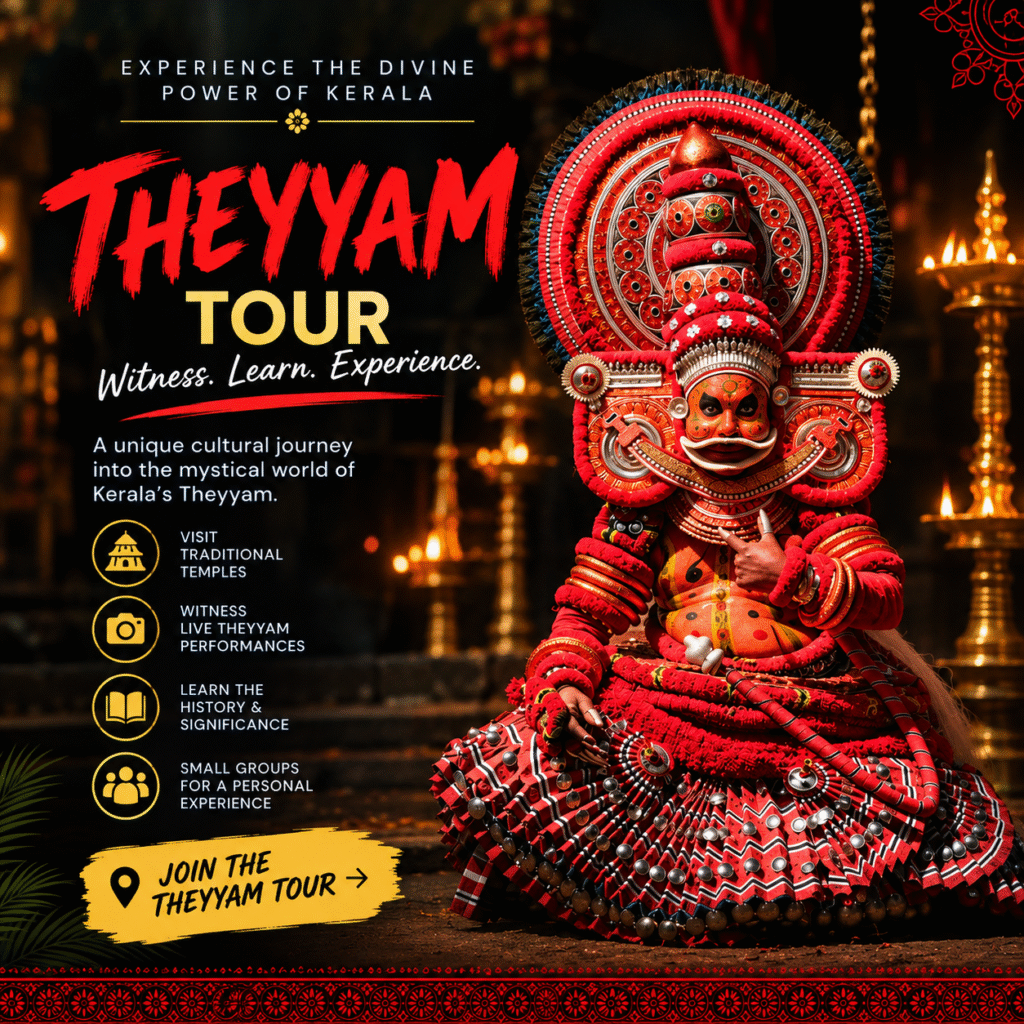
If you have never watched Theyyam before, the first things that hit you are the blood-red face paint, the towering headdress, the relentless beat of the chenda, and a performer moving in ways that don’t look entirely human anymore. That first impression is powerful — but it’s only the surface.
Theyyam is a ritual performance tradition of North Malabar, practiced across Kannur and Kasaragod districts of Kerala, in which a performer is ritually transformed into a deity, ancestral spirit, or heroic ancestor worshipped by a local community. It is one of the oldest living ritual art forms in India, with roots that some scholars trace back over a thousand years, long before recorded temple architecture in the region existed.
This guide breaks down the 10 ritual stages of a Theyyam performance, from the moment the kavu (sacred grove-shrine) is prepared to the final blessing given to devotees — written from the perspective of someone who has watched Theyyam not as a tourist attraction, but as a family and community tradition.
We’ve watched Theyyam forms including Panjuruli, Ilam Kolam, and Bappiriyan at Kolathuvayal Chirakutti Puthiyabhagavathi Kshethram, a kavu connected to our own tharavaadu (ancestral family home). That lived experience shapes everything below — because no two Theyyam performances, and no two kavus, are quite the same.
Table of Contents
What Is Theyyam?
Theyyam (also spelled Theyyattam or Kaliyattam in some contexts) is a ritual worship tradition followed largely in the Kannur and Kasaragod districts of Kerala’s Malabar region. A performer, drawn from specific traditional communities entrusted with this role across generations, undergoes an elaborate transformation to embody a deity, nature spirit, or deified ancestor connected to a particular kavu.
A single Theyyam performance weaves together:
- Ritual worship and invocation
- Thottam Pattu — traditional ballads sung to narrate the deity’s origin myth
- Percussion music played on instruments like the chenda, veekku chenda, and ilathalam
- Elaborate face painting (mukhathezhuthu) using natural pigments
- Costume, ornaments, and towering headgear (Mudi)
- Ritual dance and trance-like movement
- Direct interaction between the deity-performer and devotees
There is no single, standardized “Theyyam performance.” Every kavu follows its own version of the ritual, and every Theyyam form — there are over 400 documented forms across North Malabar — has its own costume, song, and choreography. That diversity is exactly what makes the tradition so rich to witness.
The Belief System Behind Theyyam
To understand why Theyyam looks and feels the way it does, it helps to know what the community believes is actually happening.
Theyyam sits at the intersection of ancestor worship, nature worship, and folk deity worship. Many Theyyam forms honor real or legendary figures — warriors, wronged individuals, tribal heroes — who are believed to have been elevated to divine status after death. Others represent nature spirits, animal deities (like the boar-spirit Panjuruli), or regional forms of familiar Hindu deities such as Vishnu (Vishnumoorthi Theyyam) or Shiva (Gulikan Theyyam).
The central belief is embodiment, not acting. Devotees do not see the performer as playing a role the way an actor plays a character in a play. Through preparation, ritual, music, and trance, the performer is understood to become a vessel for the deity itself during the ritual window — which is why devotees approach the Theyyam with folded hands, and why the performer is treated with the same reverence one would show at a shrine.
This distinction matters enormously for how you should behave as a visitor, which we’ll come back to later.
The 10 Ritual Stages of a Theyyam Performance
1. The Kavu Is Prepared
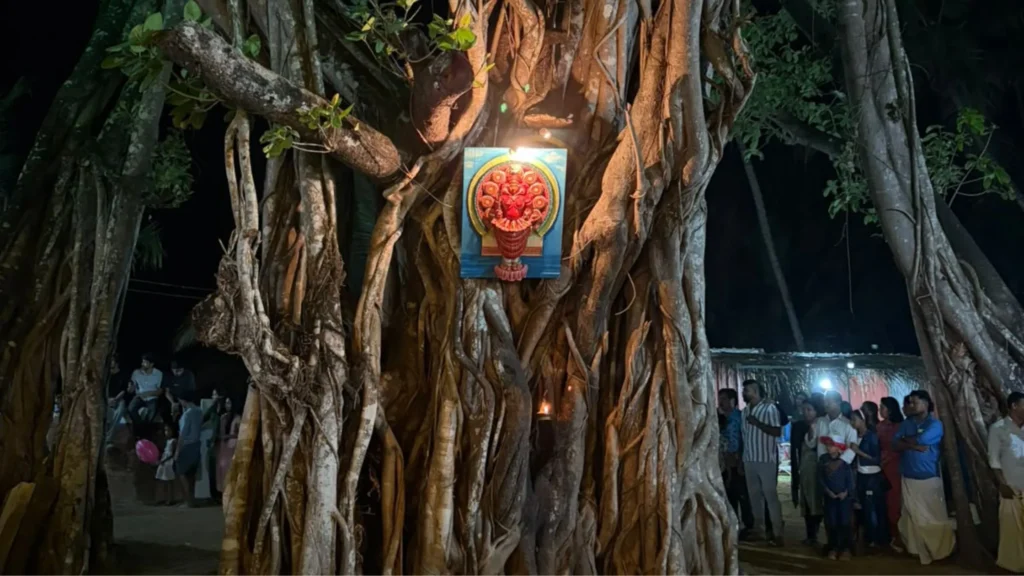
Panjuruli idol hanging from an aalmaram at Kolathuvayal Chirakutti Puthiyabhagavathi Kshethra
Before anything else, the kavu and its surrounding ritual space are readied according to that shrine’s specific customs. A kavu is not just a performance venue — it’s sacred ground tied to the deity and the community that maintains it, and preparations can include cleaning the grounds, lighting oil lamps, and arranging offerings.
At Kolathuvayal Chirakutti Puthiyabhagavathi Kshethram, this build-up is part of the experience itself. Hours before a popular Theyyam appears, the atmosphere shifts — devotees start arriving, musicians tune their instruments, and a quiet anticipation builds around the shrine. If you want to feel this yourself, exploring more of Kannur’s culture and festival calendar is a good starting point.
2. The Performer Begins Ritual Preparation
Long before the costume goes on, the performer — traditionally from communities such as the Malayan, Vannan, or other groups hereditarily entrusted with specific Theyyam forms — begins a period of ritual preparation. To an outsider this can look like simple costume prep, but within the tradition it marks the start of the transformation.
Each performer typically specializes in specific Theyyam forms passed down through their family line, and this preparation stage is where the shift from person to deity-vessel genuinely begins.
3. Mukhathezhuthu and Chamayam: Face Painting and Costume
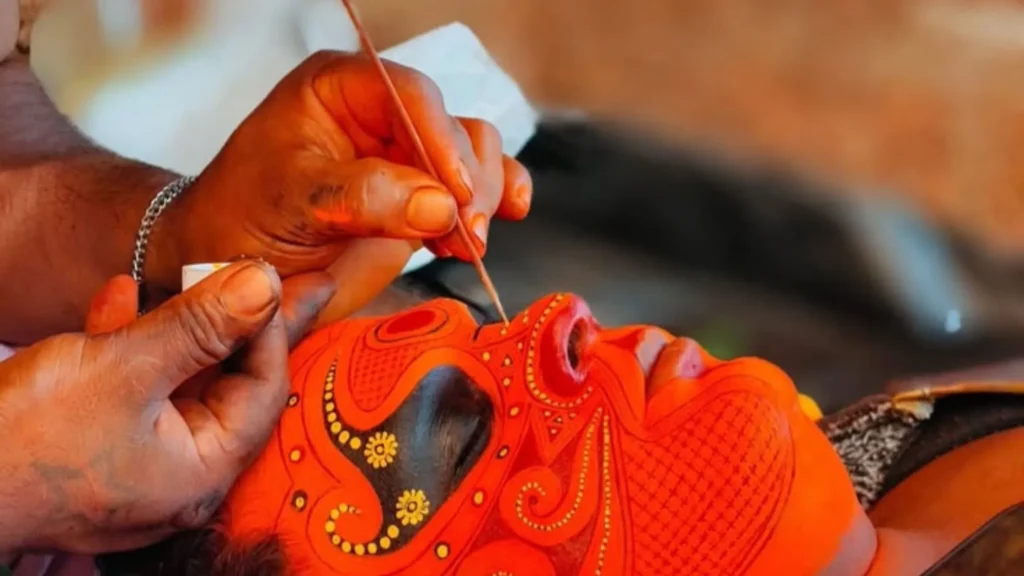
This is the stage most photographs capture, and for good reason. The face painting, or mukhathezhuthu, uses natural pigments — often in bold reds, yellows, blacks, and whites — applied in intricate patterns unique to each Theyyam form.
The costume (chamayam) is equally elaborate: colorful garments, layered ornaments, body decoration, and often a towering headpiece known as Mudi, which can rise several feet above the performer. The visual identity changes dramatically from form to form — Panjuruli’s boar-associated markings look nothing like the softer presentation of Ilam Kolam or the distinct style of Bappiriyan. This visual language is how devotees instantly recognize which deity has arrived, even before the Thottam Pattu names it.
4. Thottam Pattu: The Invocation Songs
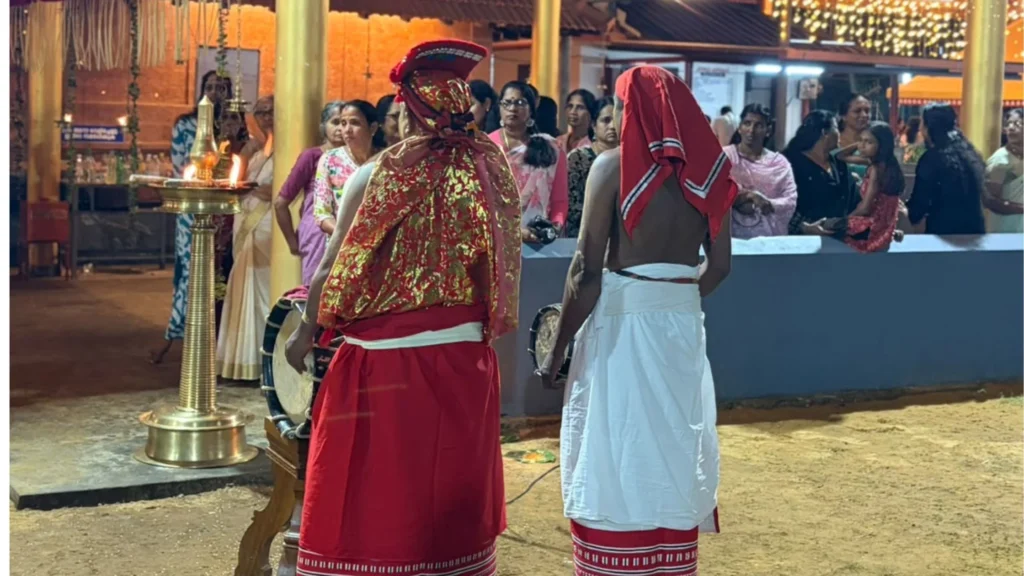
Music is not a backdrop to Theyyam — it is structural to the ritual. Thottam Pattu are ballads specific to each deity, sung to recount its mythological origin, powers, and deeds. Combined with percussion, this singing gradually transforms the emotional register of the kavu from ordinary space to sacred space.
Standing in a crowd while a Thottam Pattu builds is a different experience than watching it on video — the rhythm, the crowd’s response, and the physical vibration of the drums all combine to create an atmosphere words struggle to capture.
5. Vellattam: The Preliminary Appearance
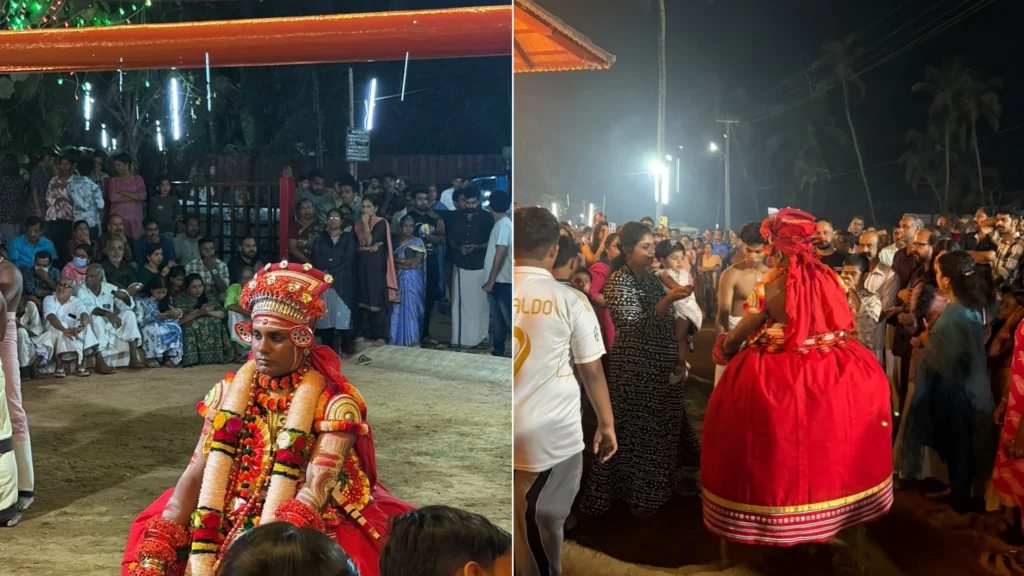
Many Theyyam traditions include a Vellattam — a preliminary, lightly-costumed appearance of the performer before the full transformation, often performed without the complete face paint or headgear. This acts as a ritual preview, building anticipation for the full Theyyam that follows and giving the performer a first movement warm-up within the ritual frame.
Not every Theyyam form includes a Vellattam in the same way, which is one more reason no two Theyyam events feel identical.
6. The Theyyam Enters in Full Form
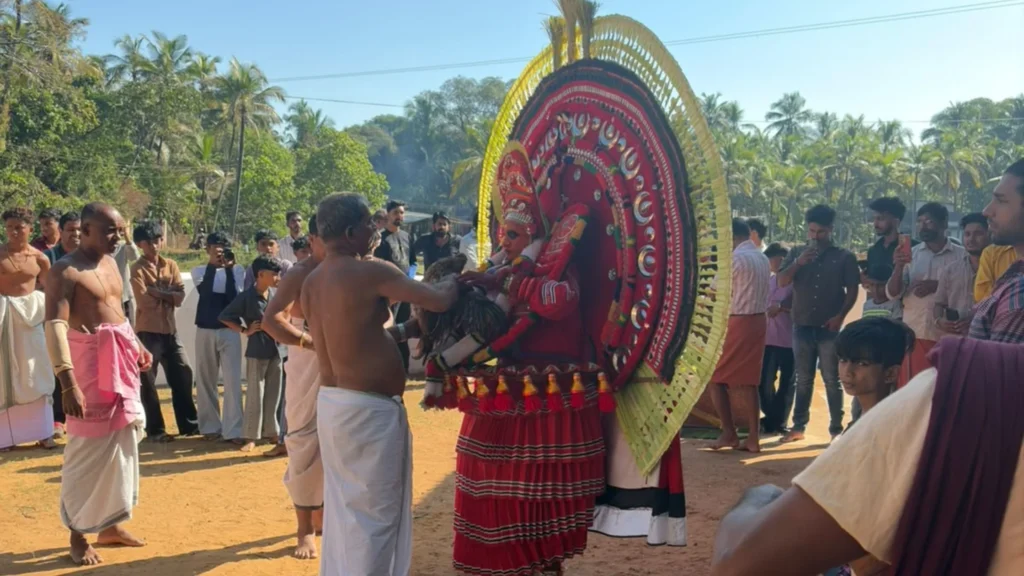
This is the moment the crowd waits for. The performer emerges in complete costume, face paint, and headdress — no longer regarded simply as a person in elaborate dress, but, within the ritual context, as the deity itself.
The crowd’s energy shifts noticeably. People press closer, others hold their ground and watch in stillness, and a palpable reverence settles over the kavu. If you’re attending for the first time, this is the moment that separates watching Theyyam as a spectator from experiencing it as a sacred event.
7. Aduthulla: The Ritual Dance
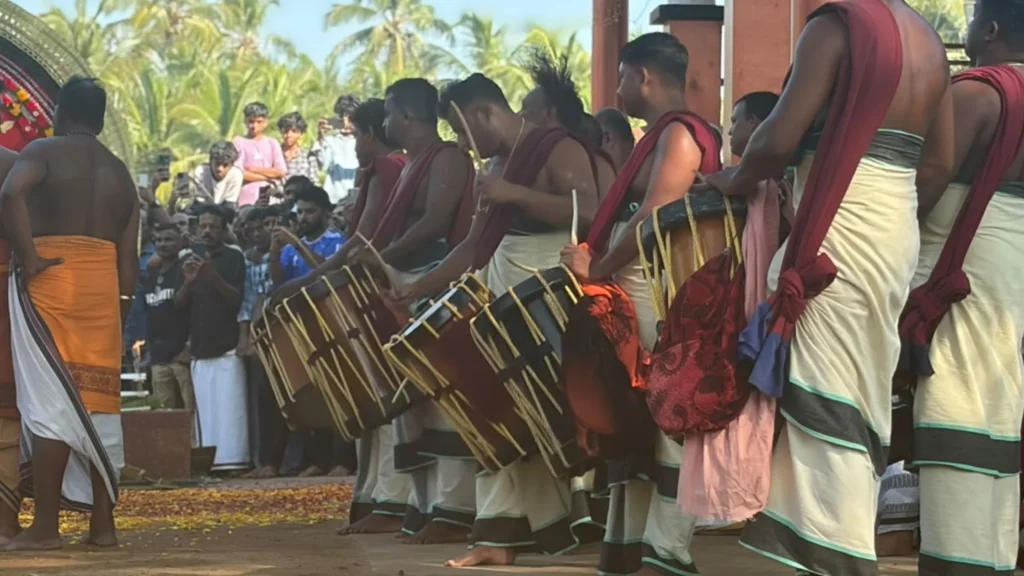
The performer now moves into the main ritual dance, known in many traditions as Aduthulla — rhythmic steps, sharp turns, dramatic gestures, and, in some forms, dramatic leaps around a ritual fire or sacred tree. The percussion intensifies alongside the dance, and the two feed off each other.
Having watched Panjuruli at a packed kavu, the intensity of this stage is hard to overstate — it’s the combination of dance, drumming, crowd energy, and firelight that creates the unforgettable atmosphere Theyyam is known for. Not every form performs identically here either; movement vocabulary varies by kavu and by the specific Theyyam’s mythology.
8. Ritual Objects and the Kalasham
Depending on the specific Theyyam, this stage may include distinctive ritual elements — ceremonial weapons, fire, sacred water (as in Kalasham rites), or other objects tied to that deity’s story. Some fierce forms like Gulikan or Theechamundi are known for dramatic fire-related elements, while gentler forms may not include these at all.
First-time visitors shouldn’t assume what they saw at one Theyyam will repeat at another — each ritual sequence belongs to that specific deity’s tradition and should be understood within its own cultural and religious context, not as generic spectacle.
9. Prasadam and Blessings to Devotees
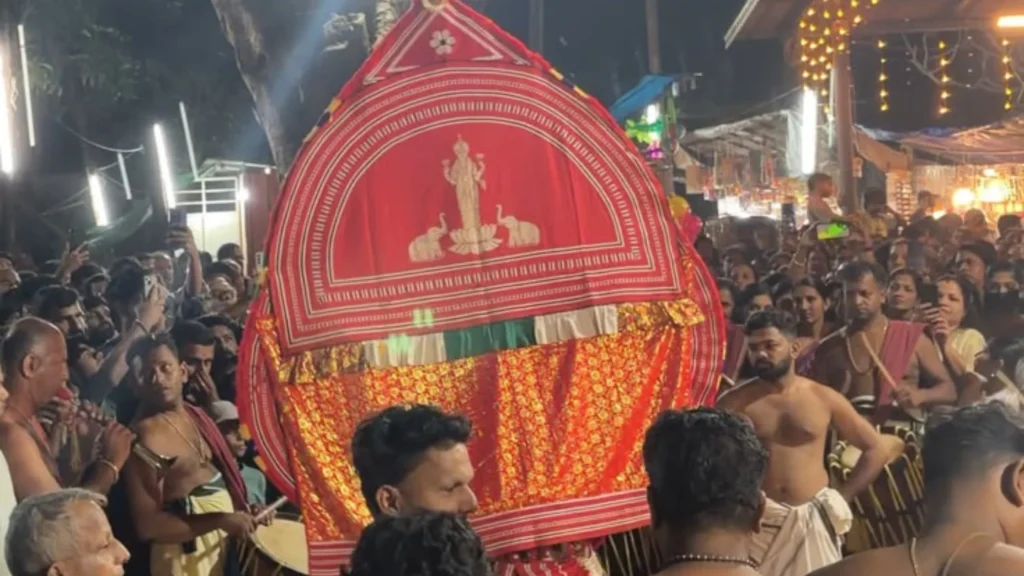
One of the most moving stages for outside observers is the direct interaction between the Theyyam and the devotees. People step forward to receive blessings, seek guidance, or make offerings, following the customs of that particular kavu.
This is where Theyyam’s meaning as lived religion — not performance art — becomes unmistakable. Many in the crowd aren’t there to watch a show; they’re there because this ritual carries real spiritual weight in their lives, sometimes tied to family history and generations of devotion at that same kavu.
10. Closing Rituals and Conclusion
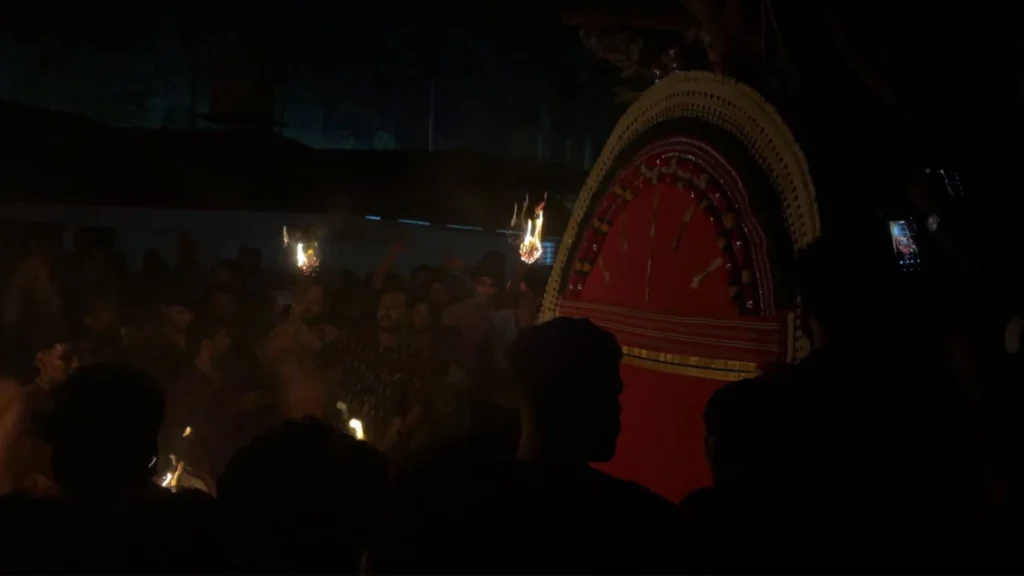
Every Theyyam eventually reaches its closing stage, and how it ends depends entirely on the kavu and the specific form — closing songs, final offerings, or a ritual procession may mark the conclusion.
Visitors should remain respectful until organizers clearly signal the ritual has ended, and should follow any instructions from those managing the kavu. The end of a Theyyam is not the end of a stage show — it’s the closing of a religious rite that will be repeated, in this same form, at this same shrine, for generations to come.
Theyyam vs. Kathakali vs. Kolam Thullal
International visitors often arrive expecting something similar to Kathakali, Kerala’s classical dance-drama, and the two are frequently confused.
| Theyyam | Kathakali | |
|---|---|---|
| Nature | Live religious ritual; performer embodies the deity | Classical performing art; performer portrays a character |
| Setting | Kavu (sacred shrine/grove) | Stage or auditorium |
| Season | October to May, tied to temple ritual calendar | Year-round, scheduled performances |
| Audience role | Devotees, active participation and blessing-seeking | Spectators watching a narrative art form |
Kolam Thullal, sometimes mentioned alongside Theyyam, refers to related folk performance traditions in Kerala that also use costume and face painting, but doesn’t carry the same singular framework of deity-embodiment central to Theyyam.
Popular Theyyam Forms You Should Know
With 400+ documented forms, no list is complete — but these names come up often and are worth recognizing:
- Muthappan — one of the most widely worshipped forms, closely associated with Parassinikadavu Muthappan Temple
- Panjuruli — a boar-associated deity form known for its intensity
- Gulikan — a fierce guardian-spirit form connected to Lord Shiva
- Vishnumoorthi — a regional Theyyam representation associated with Vishnu
- Pottan Theyyam — known for its powerful social and philosophical narrative
- Kathivanoor Veeran — based on the legend of a local hero
- Kandanar Kelan and Theechamundi — forms associated with fire rituals
- Ilam Kolam and Bappiriyan — forms with their own distinct visual identity and songs
You can explore more Theyyam performances across Kannur to see how these forms differ in costume, mythology, and ritual sequence.
Theyyam Season: When to Visit
Theyyam is not performed year-round. The primary season runs roughly from October to May, peaking between December and April, when most kavus across Kannur and Kasaragod hold their annual Kaliyattam (Theyyam festival). Outside this window, performances are rare.
If your trip dates are flexible, planning around this season — rather than around a fixed itinerary — dramatically increases your chances of witnessing a major Theyyam. It’s worth checking how to reach Kannur and building your travel dates around the local Theyyam calendar rather than the other way around.
How Long Does a Theyyam Performance Last?
There’s no fixed duration. Some Theyyam rituals wrap up in a couple of hours; others, especially during major Kaliyattam festivals, run through the night and into the following day, with multiple Theyyam forms appearing in sequence at the same kavu.
Don’t plan your visit like a one-hour stage show — treat it as an open-ended cultural and religious event, and build flexibility into your day. When mapping out your trip, it helps to plan your Kannur itinerary with extra time around your planned Theyyam visit.
What Should You Know Before Watching Theyyam?
Dress Respectfully
Remember that Theyyam takes place in a sacred setting. Wear comfortable and respectful clothing suitable for visiting a kavu.
Ask Before Taking Photographs
Photography may be allowed in some situations but restricted during certain rituals. Follow the instructions of the organisers and local people.
Don’t Interrupt the Performer
Avoid entering restricted areas, blocking the ritual space or distracting the performer while the ritual is taking place.
Be Prepared for Crowds
Popular Theyyam performances can attract large crowds. My experience at Keecheri Kolathu Vayyal Kaavu, particularly during performances such as Panjuruli, has shown me how crowded these occasions can become.
If you want a better view, arriving early can be helpful.
Don’t Treat It Only as a Tourist Attraction
Theyyam is a living religious and cultural tradition.
You can enjoy the colours, music, costumes and movements, but understanding and respecting the beliefs behind the ritual makes the experience much more meaningful.
Frequently Asked Questions About Theyyam
Is Theyyam a dance or a ritual?
Theyyam is a ritual performance tradition that combines worship, music, dance, storytelling, costumes and other ritual practices. It should not be understood simply as a dance show.
Where can I watch Theyyam?
Kannur and Kasaragod are among the best-known areas for experiencing Theyyam. Performances take place at different kavus and sacred spaces during the Theyyam season.
Are all Theyyam performances the same?
No. There are many Theyyam forms, and their costumes, makeup, songs, movements and rituals can differ. For example, Panjuruli, Ilam Kolam and Bappiriyan have their own distinctive identities and traditions.
Can tourists watch Theyyam?
Visitors can attend many Theyyam performances, but the rules depend on the particular kavu. Always respect the local customs and instructions.
Can I take photographs during Theyyam?
Photography rules vary. Ask permission where necessary and avoid photographing restricted rituals or disturbing devotees and performers.
What is the most important thing to remember when watching Theyyam?
Respect the ritual. Theyyam may look visually spectacular, but for devotees it is much more than an impressive performance. Understanding this makes the experience more meaningful.
Final Thoughts
The first time you see Theyyam, you may remember the red face paint, huge headgear, colourful costume or powerful drumming.
But after watching Theyyam more closely, you begin to notice something deeper.
The preparation, songs, makeup, costume, movements, rituals and interaction with devotees all come together to create an experience that is deeply connected with the local community.
My experiences watching Theyyam at Keecheri Kolathu Vayyal Kaavu, including Panjuruli, Ilam Kolam, Bappiriyan and other Theyyams, have shown me that there is no single way to describe every Theyyam performance.
Each Theyyam has its own identity.
And that is perhaps one of the most fascinating things about Theyyam—you can watch one performance and think you understand it, then watch another and discover something completely different.
Experience Theyyam With a Local Guide
Watching Theyyam is one thing. Understanding the mythology, the specific kavu’s history, and what each ritual stage means is what turns a striking visual experience into something genuinely memorable.
Theyyam performances are the most iconic and captivating highlight of Kannur Tourism, showcasing the region’s rich cultural heritage and vibrant traditions.Our Kannur Theyyam Tour is built around exactly that — we take visitors to selected Theyyam performances (subject to the local ritual calendar) and walk you through the traditions, stories, costumes, and cultural context behind what you’re seeing, drawing on real family and community connections to these kavus, including Madayi Kavu, one of the region’s most significant Theyyam shrines.
If you’d like help planning your visit around the Theyyam season, get in touch to book your guided Theyyam experience — and while you’re at it, take a look at other things to do in Kannur to round out your trip.