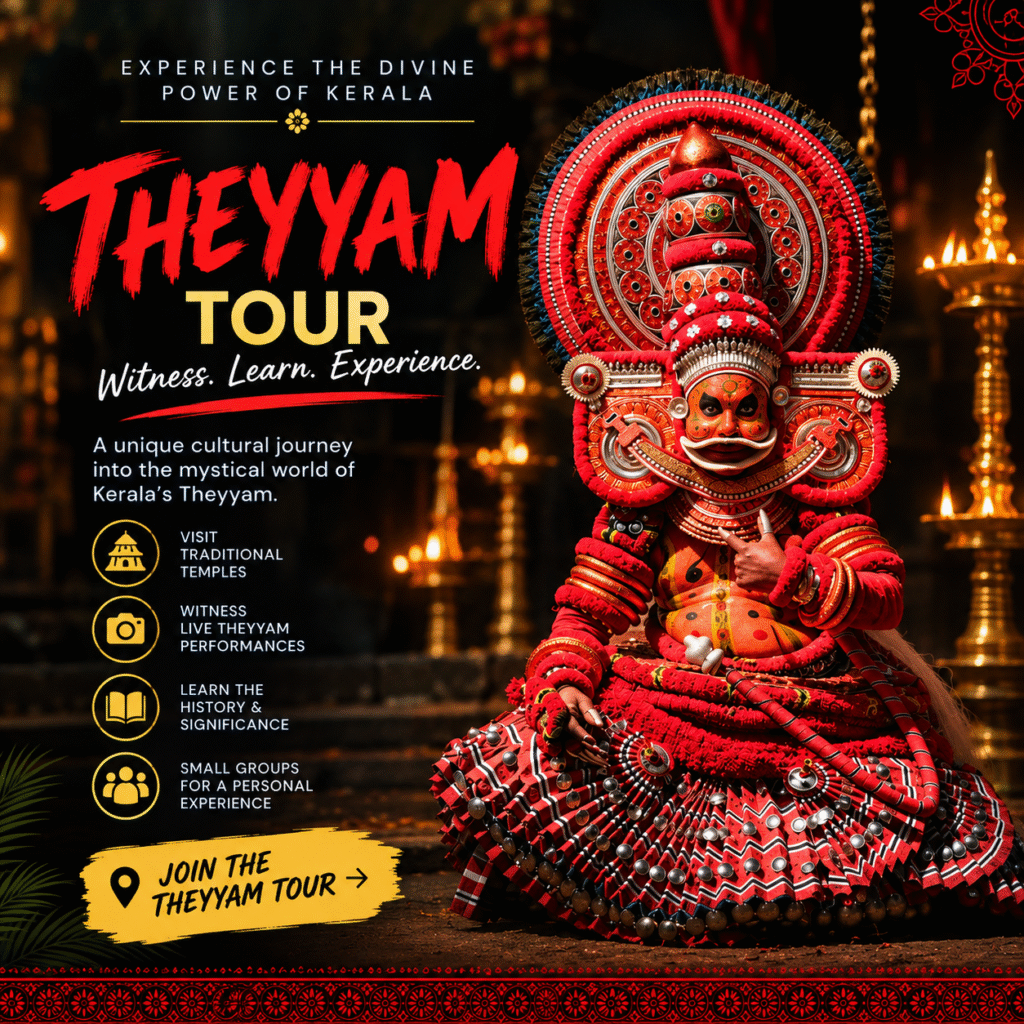
If you type “Kandanar Kelan” into Google right now, you land on scattered temple listings, one photo caption, and a handful of thin blog posts. That’s strange, because Kandanar Kelan is one of the most dramatic rituals in North Kerala. He is the only major Theyyam form whose performer runs through open fire wearing pure silk, with no coconut leaves and no fireproof layer between his body and the flames.
This guide answers the two questions everyone actually types into search bars and AI chatbots: who is Kandanar Kelan, and where and when can you watch him in Kannur. We cover the legend, the ritual, the temples, the season, and the etiquette you need before you go.
Table of Contents
Quick Facts About Kandanar Kelan Theyyam
| Detail | Information |
|---|---|
| Deity type | Deified human ancestor, elevated to godhood after death |
| Region | North Malabar — mainly Kannur district, Kerala |
| Ritual highlight | Agni Pravesham — running through open fire in silk |
| Season | October to May, part of the wider Theyyam calendar |
| Linked deity | Vayanattu Kulavan, the warrior god who revived Kelan |
| Costume marker | Two serpents painted across the chest |
| Performing communities | Traditionally performed by Malayan and related hereditary Theyyam families |
| Best known kavus | Cherukunnu area shrines, Muthachivalappil Tharavadu, Vayanattu Kulavan temples in Kannur |
Who Is Kandanar Kelan?
Kandanar Kelan is a fire deity worshipped across sacred groves, called kavus, in North Kerala. Unlike gods who exist in scripture, Kandanar Kelan started life as an ordinary man named Kelan. He died in a forest fire, and a warrior god brought him back to life from his own ashes. That rebirth is why devotees now worship him as a Theyyam — a ritual form in which a human performer becomes a living vessel for a deity during a temple festival.
Kandanar Kelan belongs to a wider group of North Malabar ancestor-gods. Like Kathivanoor Veeran or Pottan Theyyam, he began as a person from the local community, not as an imported figure from classical Hindu texts. That origin story is exactly why the ritual feels so personal to the villages that still perform it every year.
The Legend: How Kelan Died in Fire and Was Reborn
Different villages tell slightly different versions of this story, which is normal for oral Theyyam traditions passed down for generations. The core story stays the same everywhere.
The childless mother. A landowning woman named Chakki, sometimes called Meladath Chakki, could not have children of her own. While visiting the Poonkumbam forest near Wayanad, she found an infant boy. She adopted him, brought him home, and named him Kelan.
The hardworking farmer. Kelan grew into a skilled and fearless young farmer. His work brought his mother’s fields excellent harvests. Proud of his skill, she sent him to clear new farmland in a forested, hilly stretch near Wayanad so he could repeat that success there.
The fire that trapped him. Kelan set small, controlled fires to clear the undergrowth, a common farming method at the time. But the wind picked up, and the flames spread faster than he could escape. Surrounded on every side, Kelan spotted a single unburned tree and climbed it to save himself.
The snakes on the tree. That tree already had two snakes living in it. As the fire climbed higher, the snakes bit Kelan in panic. Kelan fell into the flames along with the snakes, and all three died together, burned to ash.
The god who gave him life. A hunting warrior god named Vayanattu Kulavan was passing through the forest and found Kelan’s charred remains. Using his bow, Vayanattu Kulavan touched and reshaped the ashes, and Kelan came back to life. Because he was found kandu (discovered) in this way and reborn from fire, he became known as Kandanar Kelan. Vayanattu Kulavan then gave him a place beside him as a companion deity and armed him with his own weapons.
That rebirth from fire is the reason today’s ritual performance runs directly through flames. The performer is not reenacting a myth from a distance — he is stepping back into the exact moment Kelan died and rose again.
What Happens During the Ritual
A Kandanar Kelan performance follows the same broad structure as other Theyyams, with one climactic difference: real fire, walked through in silk.
Preparation and invocation. The kavu is cleaned, oil lamps are lit, and musicians begin playing the chenda drum. A Thottam Pattu, a traditional ballad, recounts Kelan’s story to the gathered crowd before the performer ever appears in costume.
Face painting and costume. The performer undergoes mukhathezhuthu, elaborate face painting done with natural pigments, along with a full silk costume, metal ornaments, and a headdress. Unlike many other fire-related Theyyams, Kandanar Kelan does not wear a coconut-leaf skirt for protection. He performs in silk, exactly as an ordinary man would have been dressed the day fire found him.
Building the fire bed. Villagers prepare a strip of burning coconut leaves and firewood, called the melari, laid out to represent the four patches of forest Kelan is said to have cleared before the fire trapped him.
Agni Pravesham — the fire crossing. Once fully transformed, the deity-performer runs directly through this burning strip, often in both directions, expressing anger at the fire that once killed him. This is the moment crowds wait for, and it is treated as a genuine act of divine power, not a stunt.
Blessings to devotees. After the fire crossing, Kandanar Kelan moves through the crowd, offering blessings, hearing requests, and interacting directly with devotees, exactly as other Theyyam forms do in their closing stage.
If you want the general 10-stage framework that every Theyyam follows before you dive into a specific form like this one, our complete guide to Theyyam ritual stages breaks that down in detail.
Why the Two Snakes Matter
Every Kandanar Kelan costume includes two serpents painted or embroidered across the performer’s chest, usually in bold black and red. These are not decorative. They represent the two snakes that died alongside Kelan in the fire. Devotees and Theyyam scholars read this symbol as a permanent visual reminder that Kelan’s death and rebirth were shared with the natural world around him, not experienced alone. Look for this detail first when you’re trying to identify Kandanar Kelan among other fire-based Theyyam forms at a festival.
Where to Watch Kandanar Kelan Theyyam in Kannur
Kandanar Kelan is performed at village kavus rather than large public temples, which is part of what makes it feel authentic rather than staged. Known performance sites include:
| Location | What to Know |
|---|---|
| Cherukunnu area shrines (including Punnacheri Sree Chittiyil Tharavadu) | One of the most documented sites for this Theyyam, close to Payyanur |
| Muthachivalappil Tharavadu, Kannur | A well-known family shrine hosting the fire-crossing ritual |
| Vayanattu Kulavan temples across Kannur | Since Kandanar Kelan is a companion deity to Vayanattu Kulavan, he frequently appears wherever that god is worshipped |
| Village kavus near Payyanur and Ramanthali | Smaller community shrines connected to the original legend’s geography |
Because Kandanar Kelan is performed at ancestral family shrines rather than one fixed public temple, exact dates and locations shift every year based on each kavu’s own festival calendar. This is exactly where a local guide earns its value — we track the annual kavu calendar and can confirm active dates before you travel. Our Kannur Theyyam Tour is built to take you to the kavus that are actually staging performances during your visit, not just the famous ones you’ve already read about. You can also browse more Theyyam experiences across Kannur to compare forms before you decide.
Kandanar Kelan vs. Other Fire Theyyams
North Kerala has several Theyyam forms connected to fire, and first-time visitors often mix them up. Here’s how Kandanar Kelan stands apart.
| Theyyam Form | Fire Element | Protective Layer | Core Story |
|---|---|---|---|
| Kandanar Kelan | Runs through burning coconut-leaf strip (melari) | None — performs in silk only | A farmer who died and was reborn from fire |
| Theechamundi | Rolls and falls onto burning embers | Some ritual preparation, still highly intense | A fierce form linked to Vishnumoorthi mythology |
| Gulikan | Fire-adjacent ritual elements, varies by kavu | Varies | A fierce guardian spirit connected to Lord Shiva |
The detail worth remembering: Kandanar Kelan is widely described as the only Theyyam that crosses real fire in silk, without the partial protection that coconut leaves provide in other fire rituals. That is the single fact that separates him from every other fire-linked form in the tradition.
How to Reach the Kavus
Most Kandanar Kelan performance sites sit in villages around Cherukunnu, Payyanur, and Ramanthali in Kannur district.
- By air: Fly into Kannur International Airport (CNN), then travel by road to the specific kavu, depending on the year’s festival calendar.
- By train: Kannur Railway Station (CAN) connects to major Kerala and South Indian cities, with local taxis available for the final stretch.
- By road: These village shrines are reachable by local roads, but they are not always signposted for outside visitors, which is why most travelers book a local guide rather than self-driving to an unfamiliar kavu at 4 a.m.
For full transport details into Kannur itself, see our complete how to reach Kannur guide.
Visitor Etiquette Before You Go
Kandanar Kelan is a living religious ritual, not a cultural show staged for tourists. Keep these points in mind:
- Arrive early. The fire-crossing moment draws large local crowds, and a good viewing spot fills up fast.
- Dress modestly. Treat the kavu like any other sacred space in Kerala.
- Ask before photographing. Some ritual moments allow photography; others don’t. Follow the organizers’ lead.
- Keep a respectful distance during the fire crossing. The fire bed and the space around it are for the performer and ritual staff only.
- Understand it’s not a performance for you. Devotees are there because this ritual carries real spiritual weight for their family and community, sometimes across many generations.
Frequently Asked Questions
Who is Kandanar Kelan?
Kandanar Kelan is a fire deity worshipped in North Kerala’s Theyyam tradition. He began as a human farmer named Kelan who died in a forest fire and was resurrected by the warrior god Vayanattu Kulavan, after which he was worshipped as a god.
Why does Kandanar Kelan run through fire?
The fire crossing, known as Agni Pravesham, reenacts the moment Kelan died in the forest fire before being brought back to life. The ritual expresses his anger at the fire that killed him, using real flames rather than a symbolic reenactment.
Where can I watch Kandanar Kelan Theyyam?
Kandanar Kelan is performed at village kavus in and around Cherukunnu, Payyanur, and Ramanthali in Kannur district, as well as at various Vayanattu Kulavan temples, since the two deities are worshipped together.
What season is Kandanar Kelan performed in?
Kandanar Kelan follows Kerala’s general Theyyam season, which runs from late October to May, with most performances concentrated between December and April.
What do the two snakes on the costume mean?
The two serpents painted across the performer’s chest represent the two snakes that died in the same fire as Kelan. They serve as a permanent visual symbol of that shared death and rebirth.
Is Kandanar Kelan the same as Theechamundi?
No. Both are fire-related Theyyam forms, but they come from different legends and use different fire rituals. Kandanar Kelan is specifically known for running through fire in silk with no protective layer, while Theechamundi involves rolling on burning embers as part of a separate mythology tied to Vishnumoorthi.
Can tourists watch Kandanar Kelan Theyyam?
Yes, visitors are generally welcome at these performances, but exact access depends on the individual kavu’s customs. Booking a local guide who tracks the annual festival calendar makes it far easier to find and respectfully attend an active performance.
Experience Kandanar Kelan With a Local Guide
Kandanar Kelan performances happen at family and village shrines, on dates that shift every year with each kavu’s own calendar. Finding the right night on your own is genuinely difficult if you’re visiting from outside Kannur. Our Kannur Theyyam Tour tracks the active kavu schedule and takes you to performances that are actually happening during your trip, with context on the legend, the ritual stages, and what to expect before the fire crossing begins.
Get in touch to plan your Kandanar Kelan visit, or explore other Theyyam experiences in Kannur and things to do around Kannur to round out your trip.