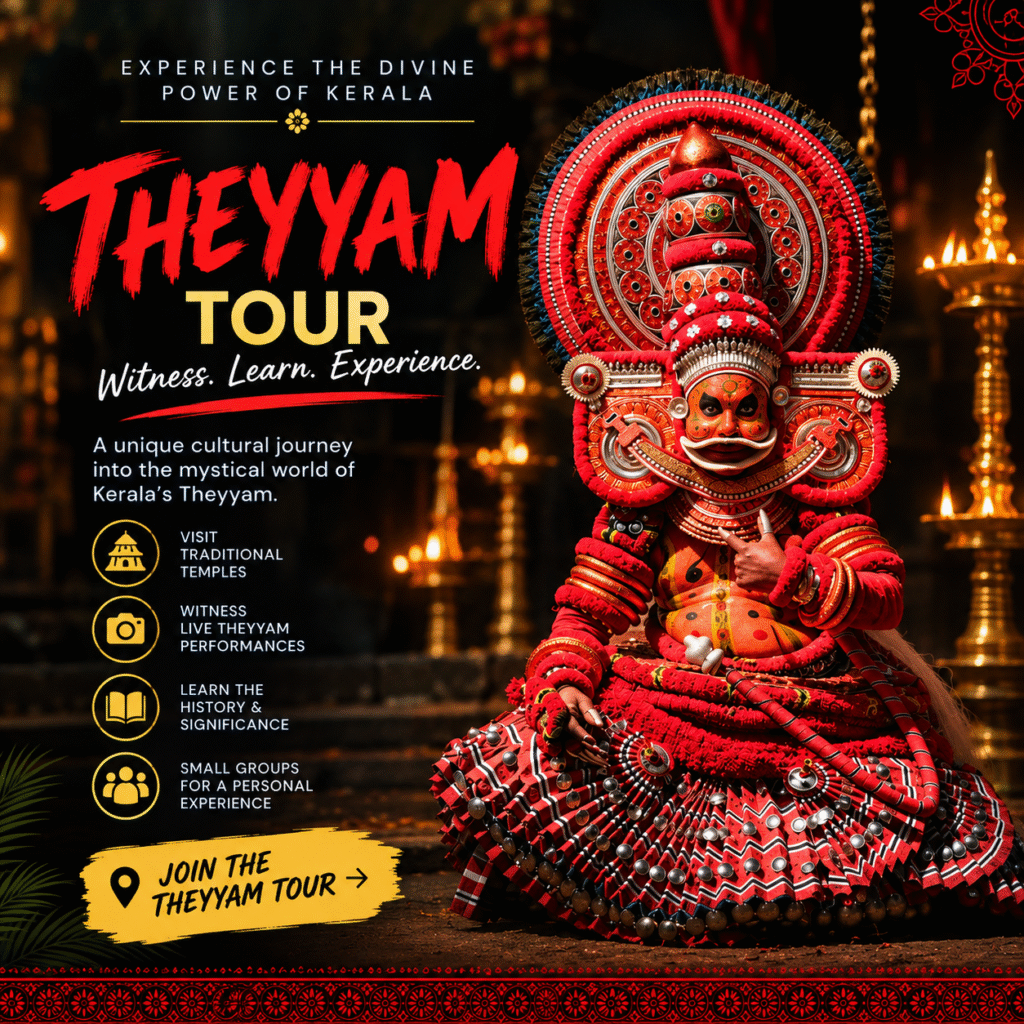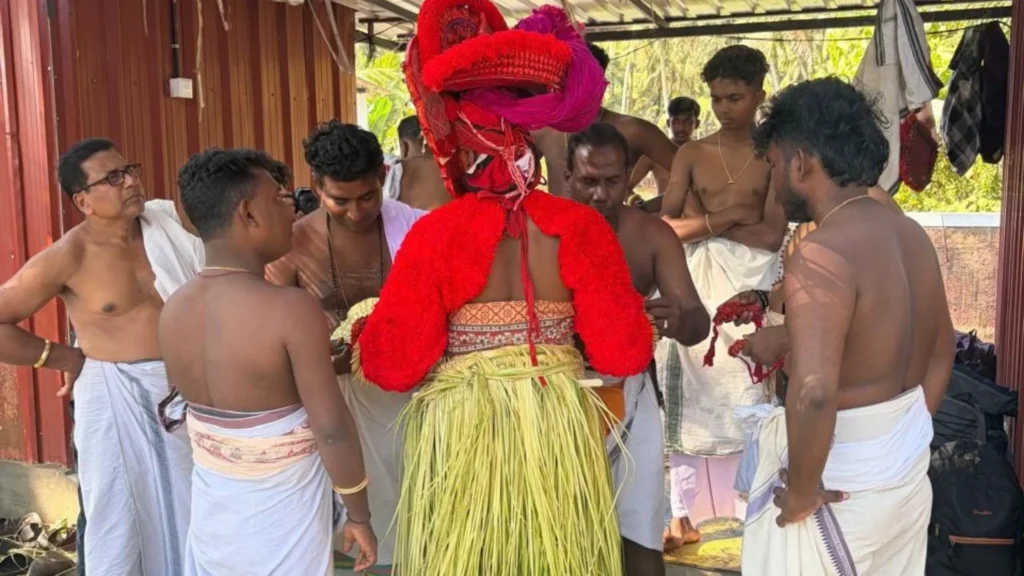
Theyyam is not a stage show anyone can learn and perform. It is a hereditary ritual right, passed down inside specific caste communities of North Kerala for generations. If you want to truly understand Theyyam, you have to understand the castes who perform it, why the right belongs to them, and what their lives look like off the ritual ground.
This guide breaks down the major Theyyam performer castes, the research behind the numbers, and the social reality that sits underneath one of India’s most striking ritual art forms.
What Are Theyyam Castes?
Theyyam castes are the specific communities in Kannur and Kasaragod who hold the hereditary right to perform Theyyam. This right is not open to the general public. It passes from father to son inside a fixed set of families, each tied to particular shrines, deities, and villages.
Most of these communities are classified as Scheduled Castes, and a smaller number belong to Scheduled Tribe groups. Outside the ritual, many of these families have historically faced caste discrimination and economic hardship. Inside the ritual, the same performer is worshipped as a living deity by people from every caste, including those who consider themselves socially “above” them in daily life. This contradiction is the single most important thing to understand about Theyyam.
If you’re new to the tradition itself before going deeper into caste history, our Experience Theyyam guide covers what a performance looks like, when it happens, and how to attend respectfully.
The Major Theyyam Performer Communities
Based on the 2015 Kerala Development Society (KDS) study — the most detailed household-level survey ever conducted on Theyyam performers — here are the primary caste communities that hold ritual performance rights, with their estimated population:
| Caste Community | Estimated Population |
|---|---|
| Vannan | 29,500 |
| Kopalan | 25,750 |
| Pulayan | 15,560 |
| Malayan | 15,400 |
| Mavilan | 5,600 |
| Velan | 5,550 |
| Anjootan / Muthuttan | 5,500 |
Total estimated performer population across these communities: roughly 1,02,860. Vettuvan is also documented as a traditional performer community, though it wasn’t broken out separately in the KDS population count.
Each of these castes doesn’t perform every Theyyam. Specific families are tied to specific deities and specific shrines — a Vannan family might hold rights to one Theyyam at one kavu (sacred grove), while a Malayan family holds rights to a completely different one a few villages away. This is why Theyyam traditions vary so much even within a short drive across Kannur district — the caste, the family lineage, and the shrine are all locked together.
Vannan
The largest performer community by population. Vannan families traditionally combine Theyyam performance with washing and textile-related caste occupations. Many of the most prominent Theyyams performed during the December–May season in North Malabar’s kavus are held by Vannan artists.
Kopalan
The second-largest group. Kopalan performers are concentrated in specific pockets of Kannur and Kasaragod and hold hereditary rights to a distinct set of Theyyams tied to their family shrines.
Pulayan
Pulayan families historically worked in agricultural labor and hold performance rights passed through generations, with strong ties to specific village-level kavus.
Malayan
Malayan performers are among the most visible in temple-attached Theyyam traditions and are also historically linked to other ritual and healing practices in North Malabar.
Mavilan, Velan, and Anjootan/Muthuttan
These smaller communities hold rights to specific, often highly localized Theyyams. Because their populations are smaller, some of their traditions are considered more vulnerable to disappearing if younger generations move away from hereditary ritual work.
Why Caste and Theyyam Are Inseparable
You cannot separate Theyyam from caste, and any content or tour experience that tries to strip that context out is giving you an incomplete picture. The Theyyam stages — from costuming and invocation to full trance — are where this contradiction becomes visible.
Here’s the core paradox, backed by research: during the ritual, a performer from a marginalized caste puts on the costume, enters trance, and is treated as a literal deity. Upper-caste devotees bow before them, ask for blessings, and follow their instructions without question. A 2015 study on Theyyam and tourism found that most SC/ST respondents viewed this reversal positively — as something that affirmed their standing and increased everyday interaction with upper-caste community members.
But the same research is clear that this ritual authority does not automatically translate into equality once the costume comes off. Caste hierarchy, economic insecurity, and social stigma have continued to exist alongside the ritual for generations. Recent academic work on Vannan performer families frames this directly: hereditary ritual rights bring dignity and recognition, but livelihood insecurity and caste stigma remain real, ongoing issues.
This is also documented in the KDS household survey, which found that a majority of performers had only basic education, seasonal income, and very limited access to social security — with just around 1.5% receiving any pension support at the time of the study.
What Recent Research Says (2025–2026)
Theyyam-caste research hasn’t stood still. A March 2026 study published in the Indian Theatre Journal, “The Theyyam Prepares: The Body and Beyond,” examines how the physical intensity of a Theyyam performance — the discipline, the bodily preparation, the voice — is directly shaped by the long-term social subjugation performers have faced as members of subaltern caste communities. The study argues that caste experience isn’t background context for Theyyam; it’s central to what the performance means.
A separate conference paper scheduled for presentation in 2026 focuses specifically on Vannan Dalit performers, comparing older and younger generations within the same families. It finds that cultural tourism and growing recognition have opened new income and visibility, but can also mask unequal ritual labor relations that still exist underneath the surface.
If you’re researching Theyyam academically or want deeper background on specific rituals and their historical roots, our Kannur blog covers individual Theyyam traditions, festival calendars, and shrine histories.
Theyyam Castes vs. General Kerala Caste Categories
It’s worth being precise here. Not every Scheduled Caste or Scheduled Tribe community in Kerala performs Theyyam, and not every Theyyam performer belongs to the same caste. The performer communities are a specific, defined subset tied to specific ritual rights — Vannan, Malayan, Velan, Mavilan, Vettuvan, Pulayan, Kopalan, and Anjootan/Muthuttan are the documented core groups.
Treat any list of “Theyyam castes” with some caution. Performer communities differ by locality, by deity, and by family lineage, so no single list fully explains every Theyyam tradition across North Malabar. What’s true in Payyannur may not be true in Taliparamba just a few kilometers away.
Where to Witness Theyyam Performed by These Communities
If you want to see these traditions performed live rather than just read about them, timing and location matter. Theyyam season runs roughly from October to May, with the highest concentration of performances in Kannur’s village kavus. Our Culture & Festivals hub lists active shrines and seasonal performance calendars so you can plan around real dates instead of guessing.
For travelers coming from outside Kerala, check our How to Reach Kannur guide first — most authentic Theyyam kavus are in villages outside the main town, and getting the logistics right matters more here than in most tourist destinations.
If you’d rather not navigate shrine etiquette, timing, and remote village routes on your own, a guided Theyyam tour with local support is the easier way to experience this respectfully and see performances by these hereditary communities up close.
FAQ: Theyyam Castes
Which castes perform Theyyam?
The main documented performer communities are Vannan, Malayan, Velan, Mavilan, Vettuvan, Pulayan, Kopalan, and Anjootan/Muthuttan. Most are classified as Scheduled Castes, with some Scheduled Tribe communities also holding performance rights.
Is Theyyam performed only by Dalit communities?
Primarily, yes. The KDS 2015 study classifies the majority of performer communities as Scheduled Castes, though some Scheduled Tribe groups also perform specific Theyyams.
Can anyone learn to perform Theyyam?
No. Performance rights are hereditary and tied to specific families within specific caste communities. They are not open to the general public or to performers outside the lineage.
Which is the largest Theyyam performer caste?
Vannan, with an estimated population of around 29,500 according to the 2015 KDS study, making it the largest documented performer community.
Why are upper-caste devotees allowed to worship a lower-caste performer during Theyyam?
During the ritual, the performer is believed to embody the deity itself, temporarily overriding everyday caste hierarchy. Research shows this reversal is symbolically powerful, though it does not eliminate caste inequality outside the ritual setting.
Sources: Kerala Development Society, “Socio-Economic and Health Problems of Theyyam Dancers Belonging to Scheduled Castes of Kerala” (2015) — kdsonline.org; Rajesh Komath, “The Theyyam Prepares: The Body and Beyond,” Indian Theatre Journal (2026) — intellectdiscover.com
Cannanore Tourism documents Theyyam and North Kerala’s ritual heritage with respect for the communities who keep these traditions alive.